
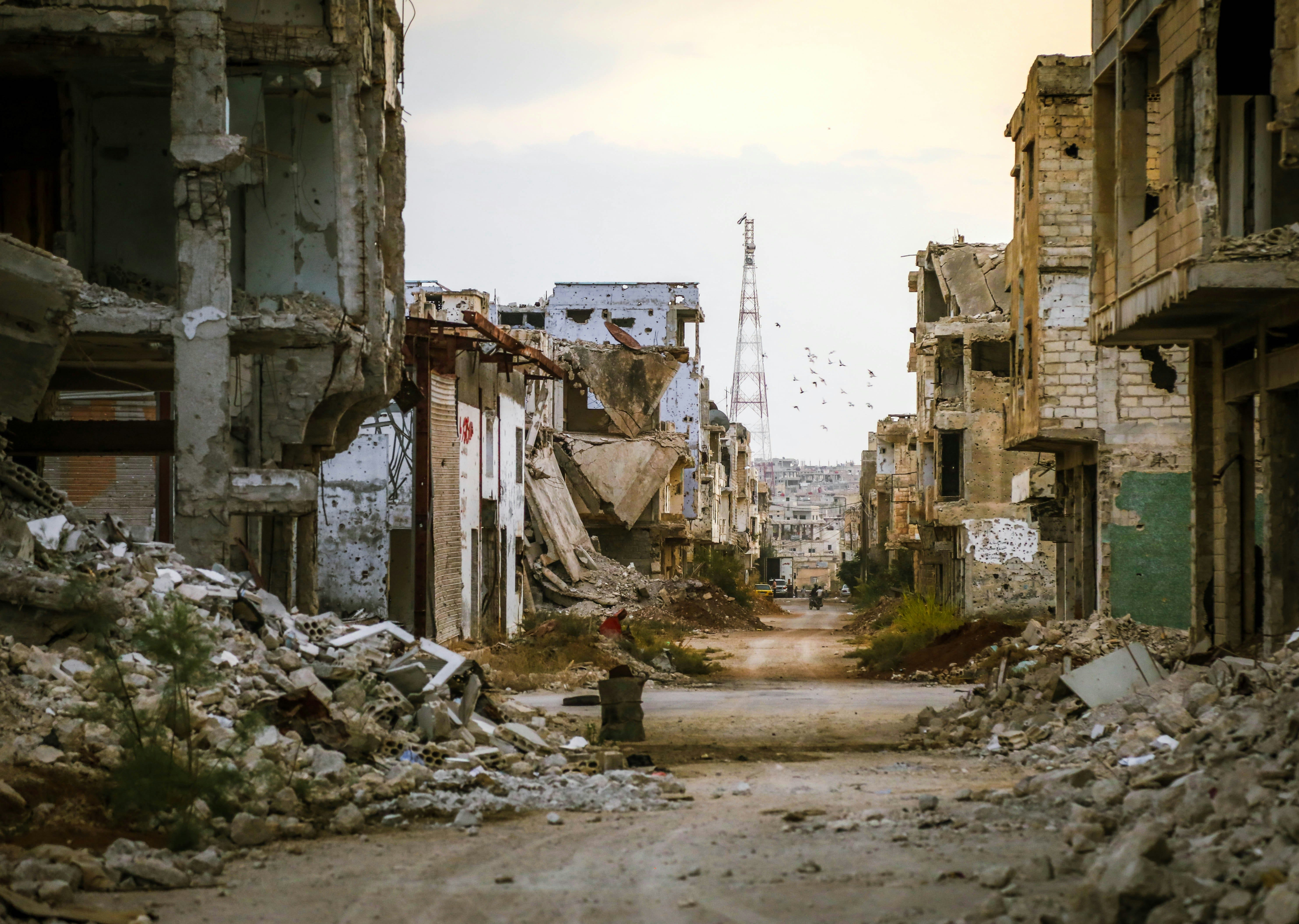
Who Will Syria Be Rebuilt For?
Although free from the Assad regime, Syrians still don't have enough say in plans for their country's reconstruction.

I have a new piece out this week for Century International, the Century Foundation’s center for international research, on the new Syrian government’s troubling approach so far to rebuilding a country in ruins:
Damascus’s battered fairgrounds, on the outskirts of the city, hosted a reconstruction fair this fall, billed as an international exhibition to rebuild the country. Like everything in Syria since the sudden fall of Bashar al-Assad’s regime in December 2024, it had an optimistic tagline, promising an “economic breakthrough” where “the future of the new Syria is written.”
Yet the reconstruction plans emerging from Syria’s new government are actually more reminiscent of Syria’s past: developments announced by decree, opaque and undemocratic decision-making, and cronyism.
The new president, former rebel leader Ahmed al-Sharaa, has worked hard to hone messaging that emphasizes inclusion and radical changes. Reconstruction, with an estimated cost of up to $400 billion—some twenty times the size of Syria’s GDP—is one of the biggest tests of Sharaa’s rhetoric. So far, the reality is falling far short of the marketing. Many Syrians are worried, and international policymakers should be, as well. Without reforms, reconstruction risks ushering in a new era of clientelism and corruption in Syria, benefiting only Sharaa’s allies and international developers, while the Syrian people continue to be locked out of the decisions that will shape their future.
Syria’s reconstruction is the focus of my writing and research as a fellow at Century International. I’m interested not only in the development and policy issues in what may be the largest postwar rebuilding effort since World War II, but also the politics of reconstruction and how they will shape Syria’s fragile transition after decades of authoritarian rule under the Assads. (My Syria connections go back to 2008-2009, when I spent a year in Damascus on a Fulbright fellowship).
A year after Assad’s fall and the end of a brutal regime established by his father, Hafez, in 1971, reconstruction barely exists in Syria, beyond pledges on paper—in the form of big-ticket investment deals with foreign companies, many from Turkey and the Gulf. Besides being short on details, these deals prioritize investment-driven real estate schemes centered in Damascus, while millions of Syrians remain displaced throughout the country, many living in tents. With the Syrian state and economy hollowed out after nearly fifteen years of war, Syria will undoubtedly require some foreign investment to cover the cost of reconstruction. Sharaa’s government has also signaled a reluctance to take on major international development loans to finance the colossus of reconstruction, instead eyeing foreign investment as its main driver. “We chose the path of reconstruction through investment; we did not choose the path of rebuilding Syria through aid and assistance,” Sharaa told an audience of financial elites at an investment conference in Riyadh in October. “We don’t want Syria to be a burden for anyone. We want to build Syria ourselves.”
…
Sharaa’s approach pins reconstruction in Syria on investor relations—and by extension, on courting foreign governments drawn in mostly by speculative real estate—rather than on Syria’s actual reconstruction needs, like basic infrastructure and housing for a shattered country. The investment pledges serve as a signal from Sharaa’s government of a new, business-friendly environment in post-Assad Syria, but one that might only serve Sharaa’s inner circle.
You can read the full piece at Century International.
This work draws on many years of writing and reporting on Syria and its civil war, especially the vast destruction of cities like Aleppo and Homs, where nothing was spared, from basic infrastructure and housing to cultural heritage sites. As the war dragged on, and with most of the world eventually assuming Assad would prevail, his regime saw reconstruction as the next stage of the conflict—a propaganda tool and vehicle for ending its international isolation, with the added bonus of regime elites cashing in on crony development schemes spun as rebuilding Syria. Assad’s regime seized on emerging reconstruction efforts to consolidate its authority and project an ultimately hollow image of triumph over the war, which masked its underlying weaknesses after such a prolonged conflict.
Without reforms, reconstruction risks ushering in a new era of clientelism and corruption in Syria, benefiting only Sharaa’s allies and international developers, while the Syrian people continue to be locked out of the decisions that will shape their future.
As I wrote in a chapter for the book Cultural Heritage and Mass Atrocities (published by the Getty in 2022), Assad’s regime was already “prioritizing what to rebuild, and what not to—projecting an exclusionary vision of ‘victor’s justice’ on Assad’s terms, while neglecting vast residential neighborhoods once held by opposition forces that the government either cannot rebuild, because it lacks the funds and resources, or will not as a form of collective punishment.” Assad’s reconstruction agenda also relied on co-opting Syria’s cultural heritage, as hastily rebuilt or restored sites like Aleppo’s Umayyad Mosque and the Ibn al-Walid Mosque in Homs became symbols of its propaganda campaign.
Before Assad’s sudden fall, it was clear that his regime’s aim was not to fully rebuild Syria and restore its urban landscape and infrastructure to prewar levels, but to use reconstruction for its own ends. “The regime has two possible areas of interest in reconstruction,” Amr al-Azm, a Syrian scholar and founder of The Day After initiative, a Syrian civil society organization, told me back in 2019. “One, as a means to reward those areas and individuals that were loyal to it. Two, for the regime’s coterie to enrich itself.”
Assad is gone, along with the regime cronies and insiders who were behind this authoritarian vision of reconstruction, if it could even be called reconstruction at all. Syria’s new rulers, under Ahmed al-Sharaa, are trying to hold together a fragile coalition of factions that toppled Assad and deliver on their lofty rhetoric about a new Syria. They promise to rebuild Syria “ourselves.” But does their push for foreign investment to fund Syria’s staggering reconstruction bill—many in opaque deals from foreign patrons and regional powers looking for a slice of Syria—cut the Syrian people out?


