

By Michael Sfard
Michael Sfard is an Israeli human rights lawyer and the author of The Wall and the Gate: Israel, Palestine, and the Legal Battle for Human Rights and Occupation From Within: How Israel’s Oppression of Palestinians Turned Inwards, from which this essay is adapted.
On October 7, the tables turned. Israeli communities were conquered, Israeli civilians became the victims of a storm of crimes; Palestinians became the conquerors, with armed men facing helpless communities. The consistent power structure that has shaped the Israeli–Palestinian conflict for eight decades was abruptly broken, and like a wave that ripples through a field of gravity, Israelis felt as though the laws of nature themselves had been shaken. The mightiest army in the Middle East, one of the strongest in the world, failed in its number one job: to protect the country’s citizens. A militia emerging from an impoverished strip of land, mired in extreme poverty that is, among other things, the product of a 16-year blockade and a global sanctions regime, succeeded where the regular armies of powerful, resource-rich states had failed. For the first time since the 1948 war, sovereign Israeli territory was under the control of a foreign armed force. The results were impossible to digest. The massacre, the abductions, the sexual crimes, the abuse. Things the mind cannot contain.
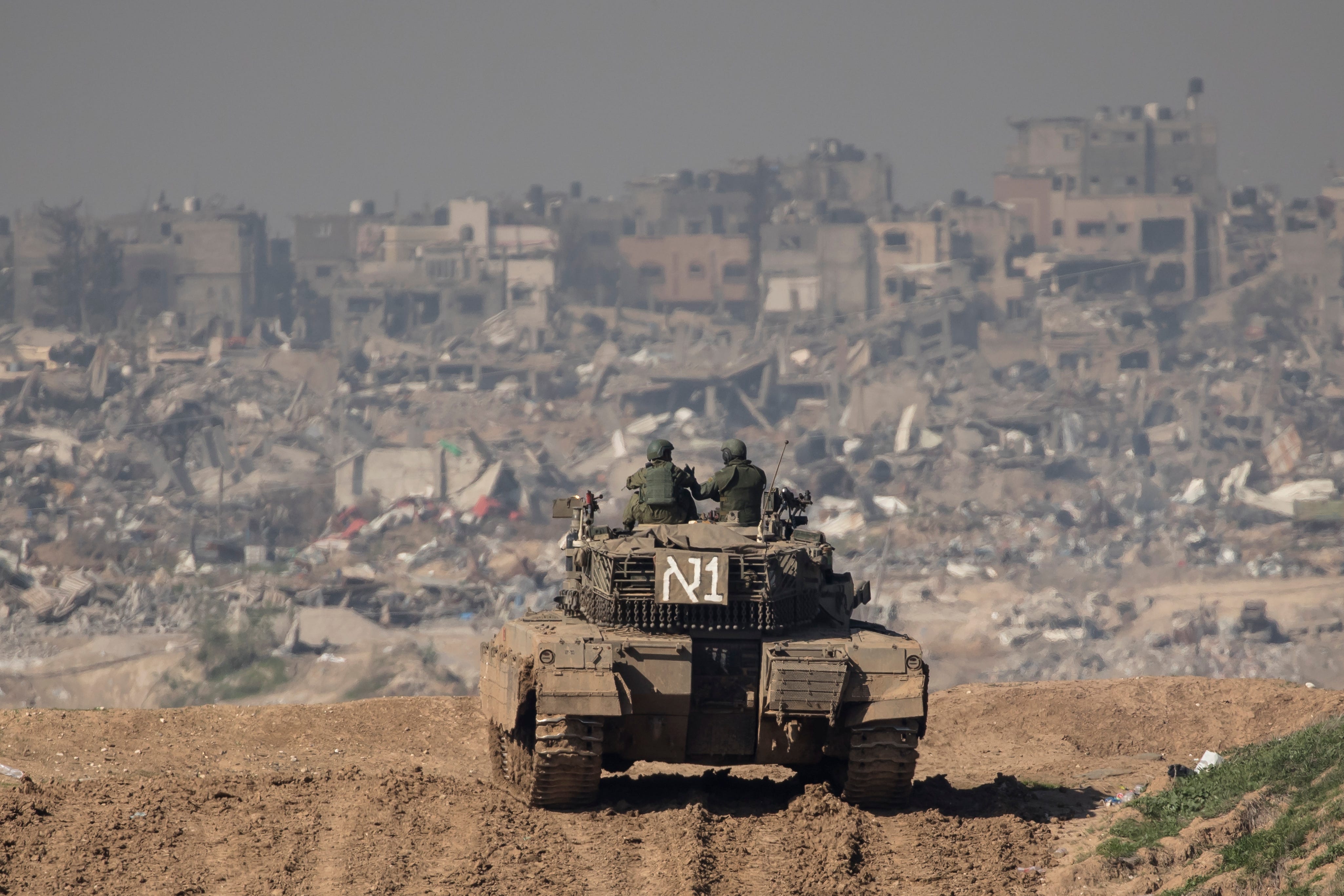
But this reversed power balance was short-lived. Within a few days, Israel repelled the attackers and launched a war the likes of which had never been seen. It rained down fire and brimstone on Gaza, leveling its surface and reducing structures built on its soil to dust. The disrupted order of the conflict quickly snapped back into place: an asymmetrical war between a modern army, equipped with the most advanced weaponry and backed by the strongest world power, and guerrilla forces hiding among a civilian population.
Two days after October 7, as the Israel Defense Forces had repelled nearly all of the Palestinian gunmen from the communities in Israel’s south, the country’s president, Isaac Herzog, wrote to the leaders of the world: “not since the Holocaust, have we witnessed scenes of Jewish women and children, grandparents—even Holocaust survivors—being herded into trucks and taken into captivity.” Three days later, Major General (res.) Yossi Peled, former commander of the Northern Command, former government minister, and a Holocaust survivor whose father was murdered in Auschwitz, was interviewed on a popular radio show. “I served in the army for 30 years,” he said. “Never, in any war—and I’ve been in crazy situations—has anything connected to my personal story of the Holocaust ever surfaced. The first time Holocaust dreams came back to me at night was after what happened in the south.”
That same day, October 12, media personality Jackie Levy’s weekly column in Israel Hayom came out. It was titled: “These Are the New Holocaust Survivors.” Levy recounted a conversation he had had with a friend from Kibbutz Kfar Aza, who had hidden with her daughter in their safe room during the massacre. “I’m a Holocaust survivor,” she told him. “The word that will come up again and again in our conversation is ‘Holocaust’,” he wrote. “As we spoke, I realized I was talking to the new Holocaust survivors, a Holocaust without the distant names of ghettos and camps, but Sderot, the Gaza-envelope communities and Ofakim, Israeliness itself. Survivors of the new Nazi scheme does not speak German and does not cloak itself in quasi-scientific racial mumbo jumbo, and, unlike the original version, is also less ‘industrial’ and more gleeful and, therefore, indescribable as this may be, a bit more diabolical.”
The many ailments afflicting Israel on October 6 raged through the body politic in the weeks and months after October 7.
In early December 2023, two months later, the Shoah Foundation, which was established by film director Steven Spielberg in the mid-1990s and has since collected testimonies from tens of thousands of Holocaust survivors, announced it was launching a project to record testimonies from survivors of the October 7 attack. “The foundation’s website notes that some 130 testimonies have already been collected as part of the project” Haaretz reported, and that some of them “chillingly evoke the Holocaust.” In late January 2024, Israel’s ambassador to the UN, Gilad Erdan, addressed the General Assembly at the ceremony marking International Holocaust Remembrance Day, wearing on his lapel a yellow badge bearing the inscription “October 7th.”
The survivor’s curse had reared its head. For many Israelis, the risk inherent in a world “contaminated with the [constant] possibility of a holocaust,” as my grandfather Zygmunt Bauman, a renowned sociologist whose books included Modernity and the Holocaust, framed it, seemed to have materialized. Feelings are very hard to argue with. The images that poured in from Israel’s south called to mind the pogroms in the steppes of Ukraine and Russia in the nineteenth century, and the prevailing mood in the country was one of a looming Holocaust. It is hard to argue with this, and the suffocating terror and profound shock that gripped so many must be respected. To belittle or sneer at them is heartless and obtuse. To my astonishment, many around the world did just that. Some did so out of moral blindness, others out of antisemitism. October 7, it cannot be denied, also unleashed waves of antisemitism.
Yet both of these, the dread—haunted by the Holocaust—that took over the Israeli public in the wake of the massacre and the resurgence of antisemitism around the world, have limits that must be clearly drawn. The truth is that October 7 bears virtually no resemblance to the Holocaust or to the pogroms. A massacre perpetrated by members of a strong majority, be it a mob or an army, against a persecuted, defenseless, and helpless minority living in its midst is nothing like a massacre carried out by an armed band of occupied subjects, living under a long, unending siege, against the citizens of a state with a powerful army surrounding them. The difference is not about severity—both are grave; murder is murder, and a massacre is a massacre. It is about the political and historical attributes of these events. The power dynamic manifested in the pogroms or in the Holocaust is the mirror image of the power dynamic between Palestinians, including Gazans, and Israelis, and those relations shape a different context for the two events.
The occupation, the siege on Gaza, the apartheid regime we had created, and the constant erosion of democratic features inside Israel, all the ills society had grown used to, melded together after October 7.
Still, after October 7, Israeli society sank into Holocaust anxiety. This public mood was partly authentic, the product of indoctrination, and partly an outcome of a calculated effort to amplify the pain and its association with the Holocaust as a way of justifying what was to come in Gaza and shoring up public support for it. After all, if it’s a Holocaust or a pogrom, then this is a war of survival, nothing less. A nuclear power (according to numerous international sources, Israel neither confirms nor denies it), with the strongest army in the region and the strongest superpower in the world as its closest ally, was facing an existential threat from an armed group using homemade weapons? That was how Israelis felt and what they were led to believe. And it is, of course, false.
This Holocaust frame of mind, both genuine and contrived, came at a tremendous cost. That brief flipping of the script was enough, especially with the Netanyahu–Ben Gvir–Smotrich government at the helm, to turbocharge all the trends that decades of occupation, discrimination, and oppression of Palestinians had set in motion in Israeli society. It all took place under the banner of an existential threat, of a looming second Holocaust. Unchecked settler violence against the most vulnerable communities in the West Bank, the killing of West Bank Palestinians by the IDF, violent suppression of village agrarian life, silencing of critical voices inside the Green Line, especially Palestinian citizens of Israel, exclusion of critics of Israeli policies from public spaces and a crackdown on classic civil rights such as the right to protest and demonstrate: the many ailments afflicting Israel on October 6 raged through the body politic in the weeks and months after October 7.
The occupation, the siege on Gaza, the apartheid regime we had created, and the constant erosion of democratic features inside Israel, all the ills society had grown used to, melded together after October 7. Boosted by a sense of righteousness and terrible injustice done to Israelis, they tipped the balance in the culture-and-values war over the soul of Israeli society, going on probably since its founding, toward the aggressive, ultra-nationalist, racist, and cruel pole. All arms of government declared war on the “enemy within,” meaning anyone who strayed from the right-wing consensus. In a move that would have been unimaginable in Israel just a few years earlier, the police commissioner ordered his officers to forcibly prevent protests against the war in Gaza, and even just against the harm to innocents there. In a clip posted on official police social media accounts, the commissioner suggested deporting to Gaza anyone who felt compassion for Gazans. Quiet protest vigils by a handful of people in Jerusalem, Haifa, and Nazareth against the massive bombardments and large-scale killing in Gaza were broken up by a brute police force. Even two years into the war, officers were still snatching signs bearing anti-war slogans from protesters’ hands.
Israel waged a war of annihilation in Gaza. Call it ethnic cleansing, call it erasure, call it genocide, call it what you will. It obliterated the physical place, and its actions were on course to wipe the people of Gaza, as a human group, out of existence. Gaza’s physical destruction was systematic, house by house, street by street, one piece of infrastructure after another. Think of your own neighborhood: your children’s school, the health clinic, the shopping center, the playground, the park, the office buildings, and the residential blocks. Now imagine that everything, absolutely everything, is gone. You have no home, no neighborhood, no community. That is Gaza’s reality. A place that was home to 2.3 million people has become one giant ground zero. Schools, clinics, shops, water, electricity and sewage networks, roads and pavements—all reduced to dust.
The question of whether there was intent to destroy, and, accordingly, whether Israel committed genocide, is crucial, certainly for the victims, who expect formal recognition of the crime perpetrated against them. But I am not one of the victims. I belong to the group that committed the crime against them, and I have to say that even if Israel can, in one way or another, evade a legal finding that it committed genocide in the narrow juridical sense of the term, it would offer me no comfort whatsoever.
Because in practice, Israel waged a war of annihilation, a war in which we effectively laid Gaza to waste. And the criminal, unforgivable project of destroying Gaza was an all-Israeli project. It could not have taken place without the cooperation of every sector of Jewish Israeli society, whether through action or silence. Hundreds of thousands of reservists, many of whom had demonstrated for democracy in the year before the war, enlisted obediently and contributed to Gaza’s erasure. For months, the Israeli home front was unwavering in its support, even when the scale of destruction and killing in the Strip was already known. Not a single professional association in Israel dared raise a moral outcry against the annihilation: not the Israeli Medical Association, whose sickening silence in the face of the systematic destruction of Gaza’s health system, and the killing of more than 1,500 medical personnel, spoke volumes; not the teachers’ unions, who fell mute as Gaza’s education system, from primary through secondary to higher education was obliterated, showing Israeli students that not all human beings are born in God’s image; and not the Israeli Bar Association, whose chair had the courage to demand the arrest of the justice minister over matters related to the constitutional coup but saw no need to say anything about the government’s transfer and starvation plans, about the bombing of Gaza’s courts, about the starvation and abuse of Palestinian prisoners in Israeli prisons, which have been turned into torture camps, or about the repugnant collaboration of the Supreme Court with all of this.
My grandmother, who survived the Holocaust after escaping the Warsaw Ghetto and hiding in attics and basements until the war ended, wrote in her memoirs that the greatest challenge in the face of the extreme inhumanity was to stay human.
The war in Gaza is the tragic culmination of all the processes Israeli society has undergone since its birth: ever deepening occupation and apartheid, intensifying repression and cruelty towards Palestinians, alongside the dismantling of democratic institutions and the erosion of liberal values that should have drawn Israeli society’s legal and moral boundaries. And amid all this, in ideology and practice, Jewish supremacy has taken root, hand in hand with a deep, perpetual sense of victimhood and Holocaust-inflected dread.
And really, what will become of a society that, captive to its own sense of boundless, axiomatic righteousness, killed tens of thousands of people, at least half of them children, women, and the elderly? Yes, they were killed in the aftermath of a horrifying and unforgivable crime. But still. My grandmother, who survived the Holocaust after escaping the actions in the Warsaw Ghetto with her mother and sister and hiding in attics and basements until the war ended, wrote in her memoirs that the greatest challenge in the face of the extreme inhumanity was to stay human.
And here, under cover of unending occupation, as Israeli politics sinks ever deeper into fascism and racism, a trend Netanyahu’s far-right government has pushed to new extremes, many in Israeli society have hardened their hearts, bought into the mantra “there are no innocents” in Gaza, and, for the first time in Israel’s history, genocidal rhetoric has been normalized and has migrated from the outermost fringes into television studios, influencers’ feeds, the Knesset, and the cabinet.
These are questions that offer no rest. They gnaw at the mind and churn the gut. Who will we be after the war? What will our political and moral visage be? In the years to come, will there still be room here for those who, like the Hebrew poet Shaul Tchernichovsky, “have faith in mankind, in its spirit great and bold,” who insist that a day will come when “nations all live in blessed peace?” Will, to borrow from another revered poet, Natan Alterman, the melody we abandoned in vain ever return? Is it true, as another iconic poet, Lea Goldberg, hauntingly asked, that “days of forgiveness and mercy shall return?”
Editor’s note: This essay is adapted from Occupation From Within: How Israel’s Oppression of Palestinians Turned Inwards by Michael Sfard, published by De Gruyter.