

Uncanny Echoes of Iraq
My new essay for New Lines Magazine on Trump channeling Bush in Iraq, while desperately insisting his war with Iran "is not Iraq."

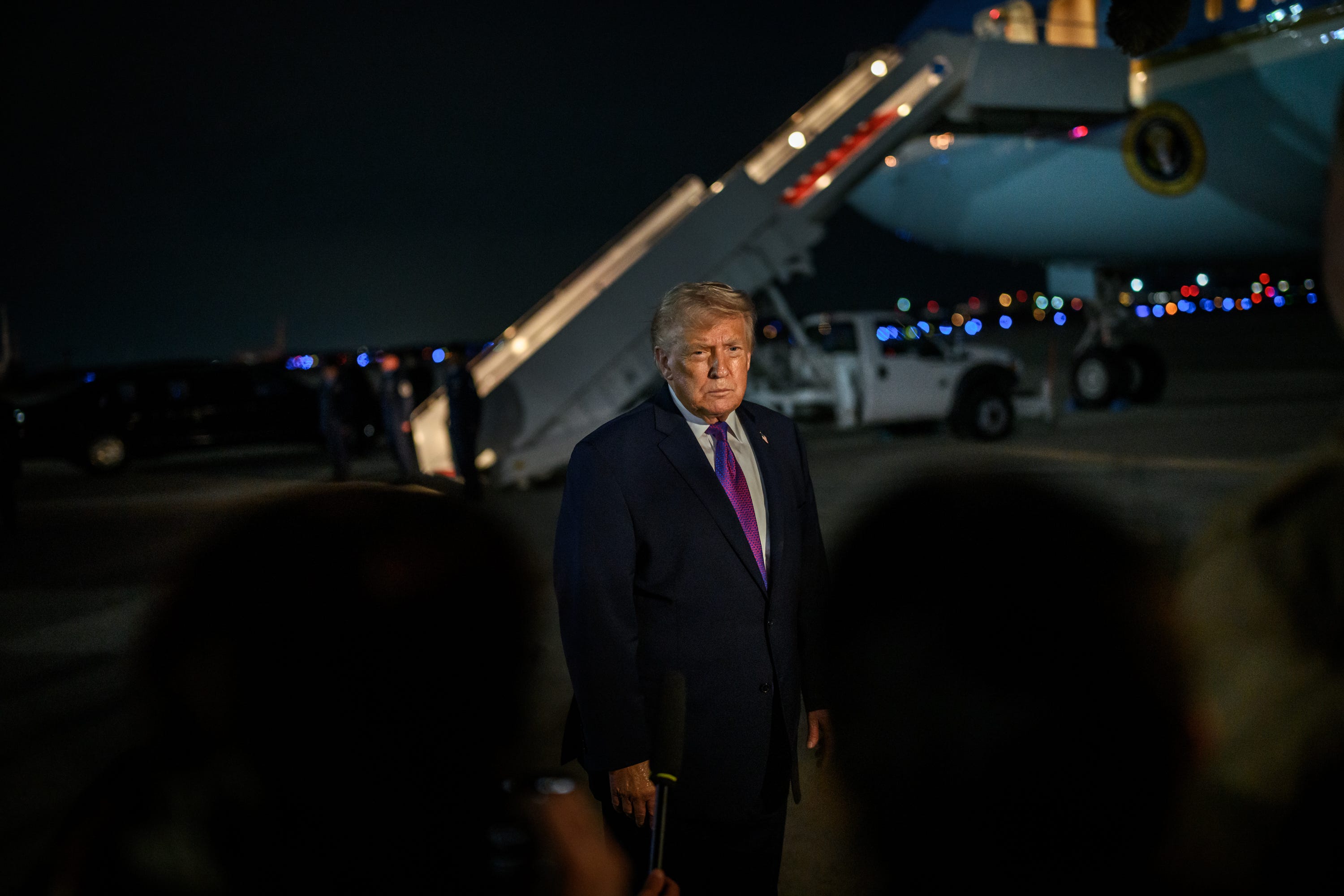
A defense secretary promises a war that won’t last more than a few weeks. A secretary of state insists on the imminent threat of weapons of mass destruction to justify a “preemptive” war. A president, in announcing the start of that war, vows to bring freedom to the people under ferocious American bombardment.
There are some clear differences between President Donald Trump’s war in Iran and President George W. Bush’s war in Iraq — most of all, the Bush administration’s long run-up to the invasion, selling Americans on the fiction that Saddam Hussein’s regime possessed weapons of mass destruction that posed a direct threat to the United States (and, for good measure, that Saddam had ties to al Qaeda). By contrast, the Trump administration made virtually no public case for war and sought no congressional approval before Trump ordered the largest buildup of U.S. military forces in the Middle East since the invasion of Iraq and then abruptly announced, in a video posted to social media at 2:30 a.m. Eastern time, that “major combat operations in Iran” were underway.
But in that video, Trump echoed — perhaps unwittingly — parts of Bush’s speech from the Oval Office on the night of March 19, 2003, when he declared the start of “military operations to disarm Iraq, to free its people, and to defend the world from grave danger.” Trump sounded an awful lot like a neocon from the early aughts, promising to deliver liberty to Iranians: “To the great proud people of Iran, I say tonight that the hour of your freedom is at hand.”
Trump’s initial insistence that Iran posed an imminent threat to the United States was similarly Bush-like. “Facing clear evidence of peril, we cannot wait for the final proof — the smoking gun — that could come in the form of a mushroom cloud,” Bush warned in a now-infamous speech in October 2002. Trump and his administration have echoed that fearmongering, claiming that Iran was just weeks away from having a nuclear weapon, even though Trump had boasted about having “obliterated” Iran’s nuclear program in a bombing campaign less than a year ago.
There are uncanny similarities in the statements of Trump and Bush administration officials trying to spin and justify their respective wars of choice. Yet Trump officials are also trying to actively combat the perception that the two wars are at all similar, no doubt to avoid any association with a generational U.S. foreign policy failure that stained Bush and the GOP’s legacy so much that Trump successfully ran against the war in 2016 (even though he had, in fact, supported the invasion at the time).
There are uncanny similarities in the statements of Trump and Bush administration officials trying to spin and justify their respective wars of choice.
Take Pete Hegseth, the former Fox News host now running the self-declared Department of War, who has insisted, “This is not Iraq … no nation-building quagmire, no democracy-building exercise.” But he has sounded at times like Bush’s defense secretary, Donald Rumsfeld, whose pronouncements now read like a catalog of imperial delusions that doomed U.S. strategy in Iraq.
In an interview in November 2002, when the Bush administration was deep into making the case for invading Iraq, Rumsfeld confidently predicted a short war. “The Gulf War in the 1990s lasted five days on the ground,” he said. “I can’t tell you if the use of force in Iraq today would last five days or five weeks or five months. But it certainly isn’t going to last any longer than that.”
Hegseth parroted that pronouncement in a press briefing on March 4, boasting that while there was no predetermined timeline for the war, it would only last a matter of weeks. “You can say four weeks, but it could be six, it could be eight, it could be three,” Hegseth said. “Ultimately, we set the pace and the tempo.”
Hegseth has backtracked on the war’s timeline, saying it was not for him “to posit whether it’s the beginning, the middle or the end.” That was up to Trump, who has recently contradicted himself several times — in some cases, in just a matter of hours — about when the war might end.
Read the full piece at New Lines Magazine.