
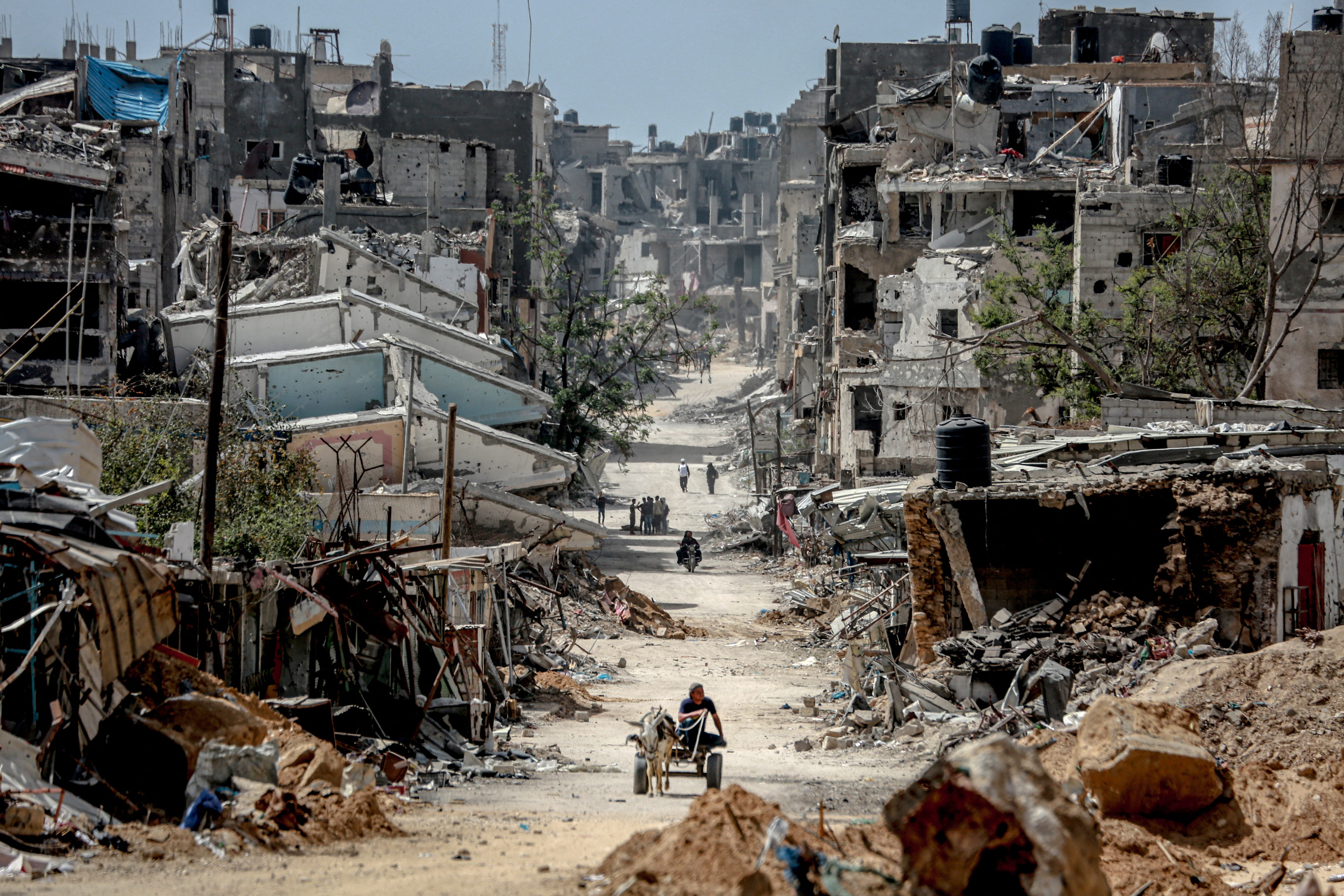
'The Tragedy of Being a War,' a Poem by Mohammed Abu Lebda
"I am a war dizzy with vertigo, nursing an unforgivable humiliation."
By Mohammed Abu Lebda
Mohammed Abu Lebda is a Palestinian poet and translator from Rafah, Gaza. His poetry has been published in Democracy in Exile, the journal of DAWN, and he has spoken about life under siege in interviews with NPR’s Here & Now and Democracy Now!. He continues to write from Gaza.
Editor’s note: The first poem I published by Mohammed Abu Lebda, in 2024, was an elegy to his fellow Palestinians in Gaza. One line in particular stuck with me about what it means to be a Gazan: “You’ll spend much of your life searching for any life.” Abu Lebda was 27 at the time and had already survived five Israeli wars. “I’m just trying to survive this madness,” he told me at the time, less than four months into an Israeli war targeting Palestinian life itself in Gaza. “We lost everything—our house, our jobs. Nothing is left.”
“Your problem, as a Gazan, is that your outlook on life is entirely different,” he wrote in that poem. “You seek only a simple livelihood, a roof made of asbestos or corrugated iron, and a battery to light up your nights untouched by electricity.”
There is an unflinching tone of grief to his poetry, giving voice to the scale of Gaza’s suffering even now, but there are also piercing scenes and details that surprise and read like reportage, demanding the world pay attention. Yahia Lababidi, a poet, writer, and Hidden Cities contributor who first introduced me to Abu Lebda’s work, has described his poetry as “a form of spiritual journalism,” with a “mystical aspect that addresses our shared humanity.” I couldn’t agree more.
“The Tragedy of Being a War”
I am a war dizzy with vertigo, nursing an unforgivable humiliation.
I massed my tanks upon the hills, unleashing my shells in blind fury to wring from you a cry of absolute terror.
Only to find you standing in the bare street, with no wall to shelter you, inhaling the scent of death as if it were a familiar, tedious guest.
I am an engine of annihilation, yet you stand before me insolently, unawed by extinction, fearing only the “amputation of limbs.”
You mock the majesty of my death, reducing my cosmic rage to mere insomnia that forces you to sleep with one eye open.
I invest tons of smart explosives to rob you of your sight, yet you provoke my arrogance with a worn-out rag, kindling a fire from the wood of your shattered doors just to brew tea.
I build a mass grave for you… yet you treat it as a front yard for your ruined homes.
You visit every morning, planting a sprig of mint at its edge, as though your dead were merely neighbors who moved to a quieter district — beneath the earth.
I grind throats to dust, and you forge a language out of hemorrhage.
I target a single man so that death may rest, only for his blood to splinter into forty likenesses.
Forty faces emerge from the victim’s torn shirt, sharing the same scar, the same uproar, confronting me with the nerve of those who have nothing left to lose.
How do I eradicate an idea that, whenever I sever its limbs, walks toward me on its heart?You have emptied my meaning of terror. I am a war that will soon die of boredom before your defiance… and oh, the insult: At my funeral, I will find no one to carry my coffin but you. You will come with missing limbs to escort a total genocide to its grave. On half-feet, you will tread with the lightness of those who conquered nonexistence, Standing at the edge of my grave, looking upon my death with the audacity of those who befriended oblivion, Casting one last pitying glance, leaving me in my pit… to rot in peace. While you rise from that very same dust! Only to realize, too late, the true trickery: All this time, I was never burying you; I was only tilling the soil, so your roots could sink deeper.


