
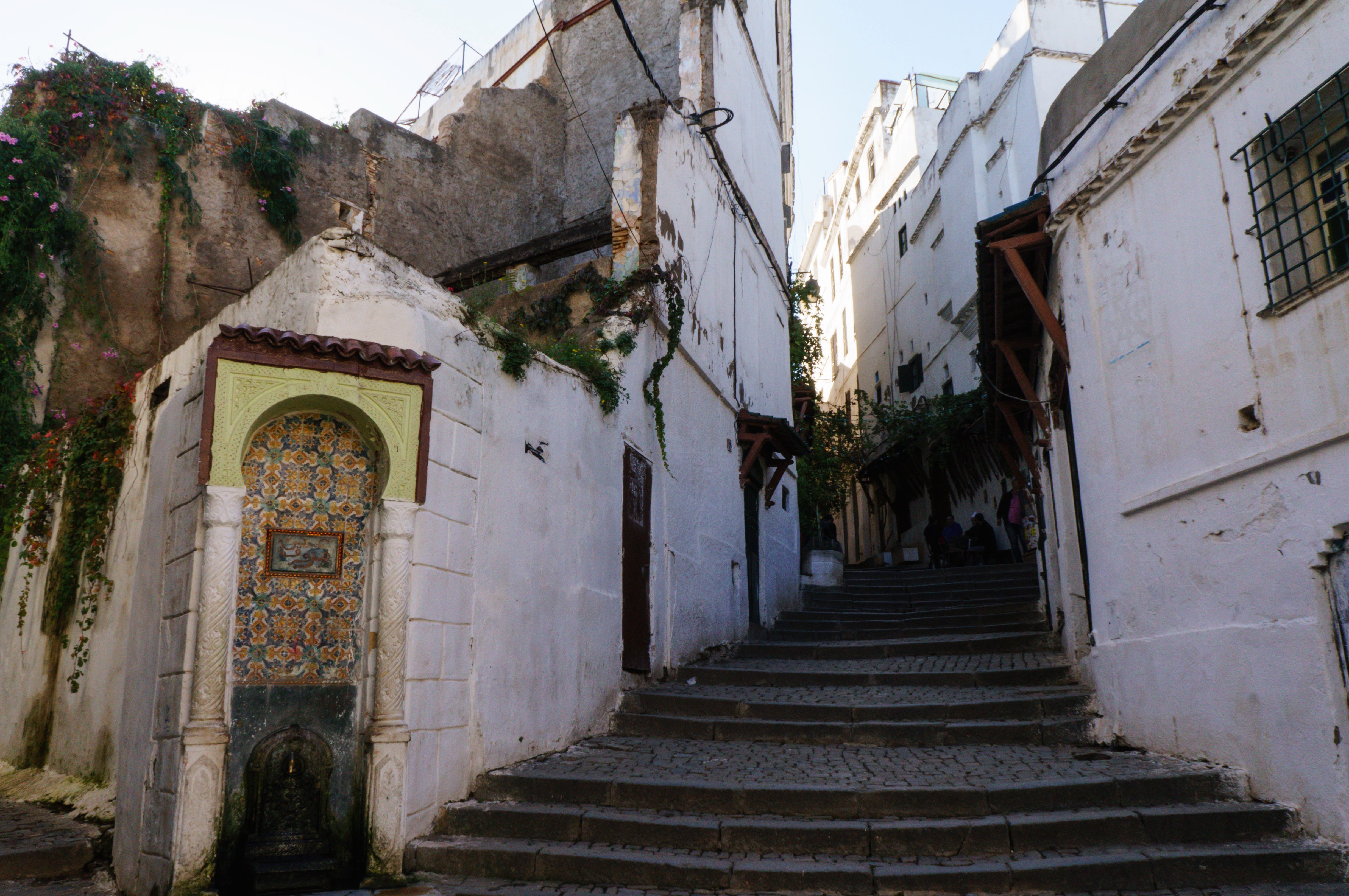
The Casbah of Algiers, a Museum in Ruins
Despite years of neglect and marginalization, the crumbling Casbah is still the beating heart of Algiers.

By Abd-el-Kader Cheref
Abd-el-Kader Cheref is an assistant professor of Africana Studies at Southern Illinois University. He has also taught at the University of Oran in Algeria. He holds a PhD in Comparative Literature and Africana Studies from the University of Exeter.
It was the hub of anti-colonial resistance that became a symbol of national identity, central to the collective memory of Algerians. A cluster of whitewashed buildings on a steep slope perched above the Mediterranean, the historic heart of Algiers is the archetype of the traditional walled city, or medina, in North Africa. But today, the Casbah is a museum in ruins.
For all its history and heritage, the Casbah has been neglected since Algeria won its independence from France in 1962, ending 132 years of colonial rule. The state’s absence is obvious in the Casbah’s crumbling and collapsed urban fabric; nearly a third of all Ottoman-era buildings “have fallen into ruin.” Vacant, rubble-strewn lots now break up many of the Casbah’s traditionally tight, meandering alleyways, which are also spanned by makeshift buttresses that hold up buildings and keep even more of them from falling down. Some 50,000, mostly poor residents still live precariously in the Casbah, some of them squatting in the ruins.
Various attempts to revitalize the Casbah have gone nowhere. UNESCO declared it a World Heritage Site in 1992, but that didn’t lead to the kind of urban restoration and architectural preservation in the medinas of Fez and Marrakesh, in neighboring Morocco, which were largely driven by tourism. Algeria’s insular government, an opaque clique of military and security elites, has been perpetually cagey about attempts to “save the Casbah,” whether by Algerian architects and preservationists, or by groups from abroad, including UNESCO itself. A plan that the government finally unveiled in 2012 to restore the Casbah never materialized due to systemic corruption and mismanagement. In 2018, the Algerian authorities struck a deal with France, for a venture led by French architect Jean Nouvel, to “revitalize” the Casbah, but it also failed due to widespread opposition in both France and Algeria over the specter of neocolonialism.
Yet despite this long history of marginalization and failure to stem the Casbah’s decline, the medina is still the beating heart of Algiers, however battered and betrayed. It remains a place of subversion and resistance—“the Mecca of revolutionaries,” as Amilcar Cabral, the anti-colonial, Pan-Africanist, revolutionary intellectual from Guinea-Bissau, described it in the 1960s.
The state’s absence is obvious in the Casbah’s crumbling and collapsed urban fabric; nearly a third of all Ottoman-era buildings have fallen into ruin.

The Casbah embodies multiple cultural, historical, and ancestral legacies: Phoenician, Amazigh (Berber), Roman, Arab, and Ottoman. The urban masterplan that exists to this day was designed by the Imazighen, otherwise known as the Berbers, under the Zirid dynasty in the 10th century. The medina was further developed and expanded by other Amazigh dynasties that ruled the central Maghreb.
The Casbah topped out during the Ottoman Regency of Algiers (1516-1830), functioning as its seat of political and military power. During the Ottoman era, it also became a city of tolerant cosmopolitanism, housing several bathhouses or hammams, such as Hammam Bouchlaghem, frequented by the city’s Jewish and Muslim communities alike. Instead of street names, every segment and alley of the Casbah bore the name of a notable family, inscribing them on the cityscape itself.
The Ottoman Regency ended with the brutal arrival of French colonialism, which remade Algiers at the expense of the Casbah. The nerve center of the city shifted to new European quarters developed along the waterfront on the Bay of Algiers, just below the Casbah. Some 2,000 houses were razed to make way for Haussmann-style buildings and residences, as a new colonial city expanded directly around the medina.
This was the urbanism of French colonial rule across North Africa. Colonial authorities and planners sought to create new “European cities,” which they saw as ordered and rational—built adjacent to and often encircling the existing medina, which they considered inherently chaotic, disorderly, and difficult to police and control.

In Morocco, General Hubert Lyautey, the head of the French colonial protectorate from 1912 to 1925, insisted that this “dual-city” would demarcate cultural separation between colonizer and colonized. “Touch the indigenous cities as little as possible,” Lyautey declared. “Instead, improve their surroundings where, on the vast terrain that is still free, the European city rises—following a plan that realizes the most modern conceptions of large boulevards, water and electrical supplies, squares and gardens, buses and tramways, and also foresees future extensions.”
The French applied that colonial logic to the Casbah over 132 years of colonialism in Algeria with a series of “interventions”—the most ambitious (and notorious) of all by the architect Le Corbusier in 1931, which he unveiled to mark Algeria’s 100th anniversary as a French colony. His modernist fantasy would have imposed a monolithic megastructure “directly over the Casbah, with its elevated highway and bridges allowing high-speed travel over the prohibitively narrow and complex streets below.” It was, perhaps, the ultimate expression of colonial urbanism in all its disregard for local life and context.


During the War of Independence that finally ended French colonial rule, fought from 1954 to 1962, the Casbah was a stronghold of the Algerian resistance. It sheltered the mujahideen of the National Liberation Front, or FLN, who waged their guerrilla war from the Casbah’s labyrinthine streets, which hampered the French military’s “all-seeing” surveillance.
The fighting culminated in the pivotal Battle of Algiers in 1957, which was memorialized in film by Italian director Gilo Pontecorvo, who depicted the harsh urban warfare and French counterinsurgency tactics, as well as the moral complexities of the conflict between Algerian independence fighters and elite French paratroopers. On the ground, the French army achieved a tactical victory by dismantling the FLN networks in the Casbah, but only through torture, reprisals, and other brutal tactics that led to strategic defeat—by turning international public opinion against French colonialism and bolstering support for Algerian independence.
The Battle of Algiers made the Casbah into a powerful symbol of anti-colonial resistance, commemorated today in sites like the Ali La Pointe Museum, which opened in 2006. This modest museum in the center of the Casbah is the site of the hideout where, in 1957, Ali La Pointe and other resistance fighters—Hassiba Ben Bouali, Mahmoud Bouhamidi, and eight-year-old Petit Omar—were all killed in a bombing by French paratroopers when they refused to surrender.
Despite being the stage for Algeria’s independence struggle, the Casbah did not reclaim its central space within Algiers in 1962, when the French finally left. Under the FLN, which transformed from revolutionary movement to military regime, the Casbah remained neglected. It also saw an exodus that drained it of much of its livelihood. The beldiya, or native families, moved to more spacious European-style apartments in nearby districts such as Bab El Oued, on the waterfront north of the Casbah, or the posh suburb of El Biar—neighborhoods planned and built under the French. They were systematically replaced by “provincials”—rural migrants—as the Casbah became an overcrowded urban ghetto. Today, the Casbah’s population is made up of the marginalized echelons of Algerian society, while an acute housing crisis has exasperated the district’s overpopulation. Many original owners abandoned their properties, unable to pay to maintain or renovate them, leading to rampant but opaque property flipping, with houses continually leased and sub-leased, and squatters moving in.

Yet despite all this, with its narrow, stepped streets, much of the Casbah still operates like it did centuries ago. Cars cannot navigate the tight curves and tortuous alleyways, so donkeys are often used for delivering provisions and supplies, and even picking up trash. And the Casbah today still maintains its citadel, hammams, mausoleums, mosques, palaces, and wast al-dar—traditional houses with large central courtyards—though many are in desperate need of repair.
The overall preserved urban and architectural integrity of the Casbah is not on account of the Algerian authorities, what many Algerians call the shadowy pouvoir, or powers that be. It is because of the ingenuity and care of individual Algerians. The absent government has its attention elsewhere. No government buildings have been erected in the Casbah, and no Algerian officials or their clientele live there, preferring instead the leafy suburbs and European quarters, like the French colonial authorities before them.
For all its neglect, the Casbah still embodies the resilience of the Algerian people.
While the Casbah has decayed throughout the post-independence era, it has still fostered popular movements and anti-government resistance, as it did under French colonialism, thanks to its urban topography. It was in the Casbah that the youth who took part in the riots of October 1988 sought refuge. Those riots, which were sparked by spiraling economic and social crises, were the first real challenge to the legitimacy of Algeria’s leaders since independence. During the ensuing “dark decade” of civil war in the 1990s, the Casbah’s layered network of narrow streets, tunnels, and terraces created a haven for Islamist insurgents that the regime’s counter-surveillance could not effectively monitor—also like the French colonial authorities before them.
The Casbah’s maze-like warren of ancient streets played a key role during the Hirak protest movement that began in 2019 and led to the resignation of Abdelaziz Bouteflika, the longtime president. Just as it had been during the war of independence, the Casbah was used as a safe haven by Hirak protesters, who despite their peaceful nature, were still targeted by Algerian authorities in a severe crackdown that included mass arrests and prosecutions, including for trumped-up “terrorism” charges.
As Issam Larkat, an Algerian photographer, has put it, “Preserving the Casbah is not just a matter of safeguarding historical architecture, but is also about protecting a living testament to Algeria’s struggle for independence and cultural identity.” For all its neglect, the Casbah still embodies the resilience of the Algerian people. In many ways, it is a symbol of all they have endured.

