
Selling Syria's Reconstruction
My new piece in Foreign Policy on Sharaa's murky investment campaign to rebuild the country, pitching high-rises amid all the rubble.

On a recent visit to Europe, Syria’s former rebel leader-turned-president, Ahmed al-Sharaa, had a pitch that would have been hard to imagine just a year and half ago. He told a packed audience at Chatham House in March that his government was trying to “transform Syria into an economic destination” for the entire Middle East. By investing in Syria’s reconstruction, Europe could tap into what Sharaa called the country’s “strategic geopolitical location in the region” while allowing millions of Syrian refugees to finally return home.
Sharaa has been busy making a version of this pitch ever since he toppled Bashar al-Assad’s regime in December 2024. Whether hosting foreign officials in Assad’s old presidential palace, or traveling abroad to meet heads of state such as British Prime Minister Keir Starmer, German Chancellor Friedrich Merz, and U.S. President Donald Trump, Sharaa has honed an investor-friendly message for how his country might rebuild after decades of dictatorship and civil war.
Indeed Sharaa’s foreign itinerary as president has often looked more like an investment tour. He has made four trips each to Turkey, Qatar, and Saudi Arabia; three to the United Arab Emirates; and two each to Russia and the United States. They correspond with early investment pledges for reconstruction, including a slew of projects unveiled last year that made headlines with their $14 billion price tag. In all, since coming to power, Sharaa’s government has touted tens of billions of dollars in investment deals to rebuild the country. These include major energy infrastructure such as power plants and oil and gas pipelines but also fanciful, speculative real estate schemes that you’d expect to see somewhere in the Gulf, not in one of Syria’s many war-ravaged cities.
The question now is, can Sharaa deliver on his lofty promises of a “new Syria” rising from the ruins? The answer may hinge on whom the real customer is for Sharaa’s rebuilding: ordinary Syrians or wealthy foreign investors.
Sharaa the salesman can sound as if he is putting investment—some of it from shady business barons with ties to the Assad regime—over the dire needs of the many Syrians who lost their homes in the war.
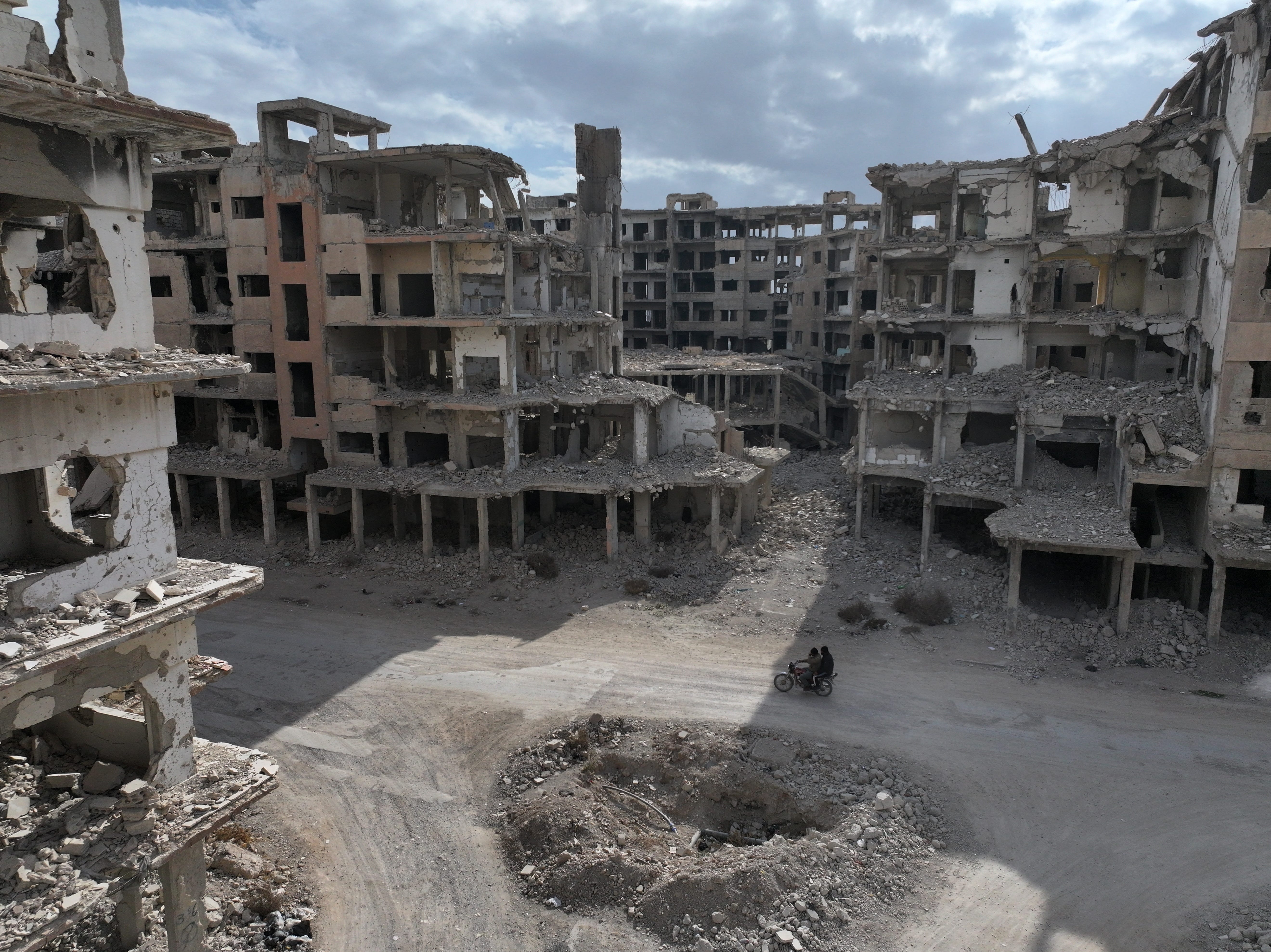
Given the enormity of destruction across Syria, where many cities and towns still look as though the war only just ended, the government’s need for investment is easy to understand. Reconstruction is estimated to cost upwards of $400 billion ($80 billion just to rebuild housing, according to the United Nations), and that’s in a country with a GDP of some $20 billion (down from $60 billion before the war) and a decimated economy.
Strikingly, Sharaa’s government has publicly shunned international loans and aid, instead prioritizing foreign investment to fund reconstruction. “We chose the path of reconstruction through investment. We did not choose the path of rebuilding Syria through aid and assistance,” Sharaa told potential investors last October at a financial conference in Riyadh. He has said this approach is intended to make sure Syria is not a “burden for anyone.” But it is also true that loans and assistance, whether from foreign countries or the International Monetary Fund, would come with outside scrutiny and potential strings attached.
Whatever the motive, Sharaa continues to tell audiences that the opportunity in Syria is enormous and there’s room for everyone. It is an urgent pitch for a leader whose hold on power may ultimately rest on whether his government can bring in money to provide jobs and restore livelihoods for millions of Syrians impoverished by the war. “The economy is still the soft underbelly for this government, and tied to that is reconstruction,” said Amr al-Azm, a Syrian scholar and founder of The Day After project, an NGO that supports Syria’s democratic transition. As he explained, “If you’re not able to get people back to work, if you’re not able to provide for them, if you’re not able to rebuild their homes, then how’s that going to work out?”
But Sharaa the salesman can sometimes sound as if he is putting investment—some of it from shady business barons with ties to the Assad regime—over the dire needs of the many Syrians who lost their homes in the war. The conflict destroyed more than 60 percent of Syria’s infrastructure, while 90 percent of the population lives in poverty. A vast sea of rubble surrounds Damascus—what was, before the war, the capital’s densely populated suburbs—while the centers of cities such as Homs and Aleppo have been in ruins for years.
“You have 2 million people sitting in tents in Idlib. Why aren’t you trying to house them? Why are you focused on investment?” Azm said. “They’ll announce some big project that’s supposed to be part of the ‘recovery,’ but it is not going to rebuild a country that has suffered such catastrophic losses or turn the economy around.”
Read the rest of the piece in Foreign Policy.


