
Scholar Dalia Ghanem on the End of the Gulf’s Gilded Age
For Gulf states fearing the Iran war’s fallout, “narrative control is economic survival.”

In April, Dalia Ghanem, a scholar based at a think tank in Qatar, published an article with the German Marshall Fund on how the Iran war had abruptly ended what she called the Gulf’s “gilded age.” Barrages of Iranian missiles and drones, fired in retaliation for U.S. and Israeli bombardment, had shattered the Gulf’s image as a luxurious—and well-protected—island of stability in a region wracked by war. “For years, residents of the Gulf’s gleaming metropolises—Doha, Dubai, Riyadh—existed in a state of geopolitical disbelief,” she wrote.
A senior fellow and program director at the Middle East Council on Global Affairs in Doha, Ghanem had moved to Qatar, like so many expatriates in the Gulf, seeking the regional “exception,” that “rare corner of the Middle East where continuous conflict was a data point for a policy brief, not a vibration in one’s windows.”
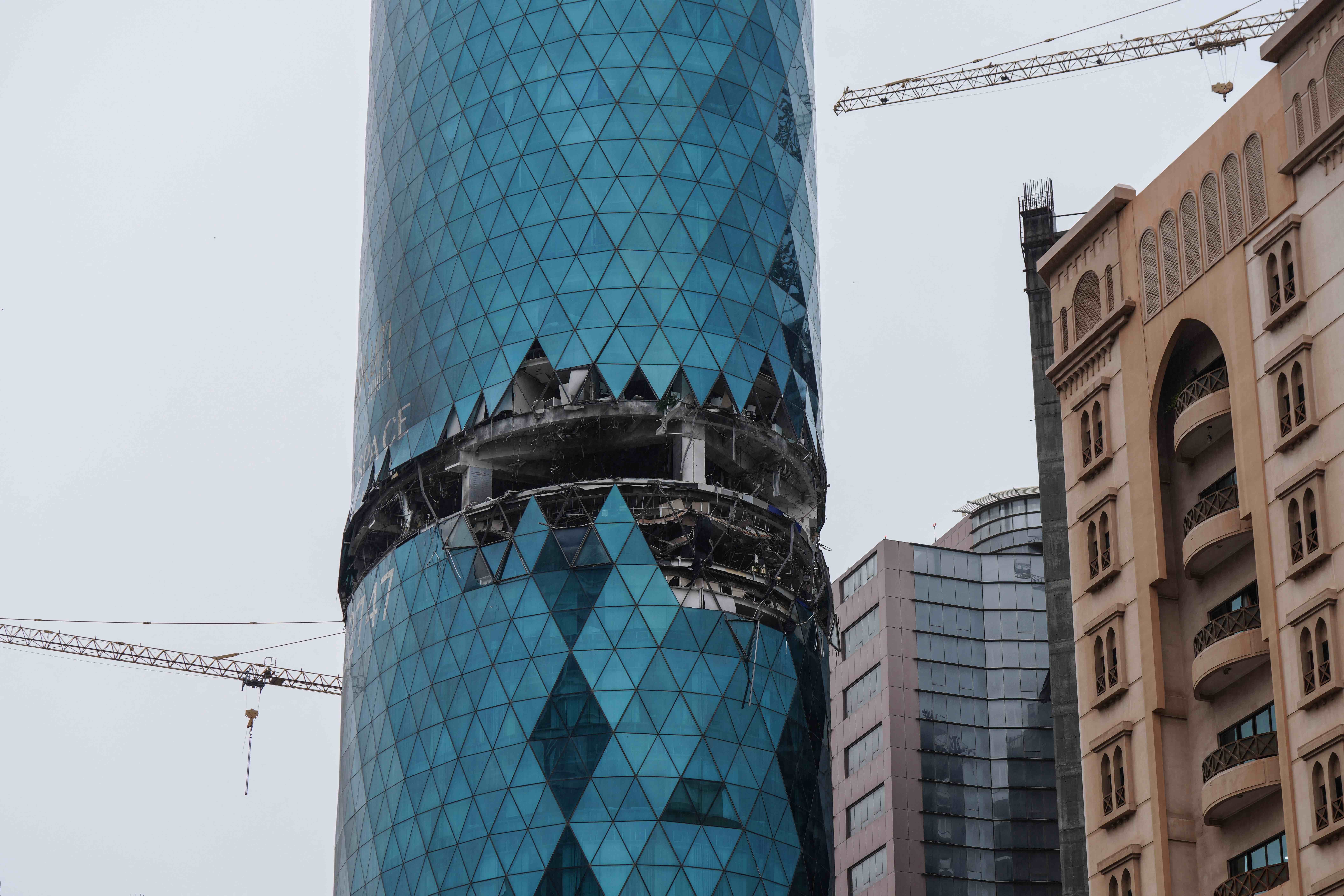
So much for all that. Iranian retaliation—not only at American military bases in the region but at the glassy high-rises that define the futuristic cityscapes of Dubai, Doha, and other Gulf cities—had punctured that mirage. “The security alerts that wail across Gulf capitals are the audible collapse of a decade of security branding,” she wrote, exposing the supposed “umbrella” of U.S. protection as instead a “magnet” for Iranian attacks. What’s more, Ghanem argued, the war threatened the foundational “myth” of the Gulf’s entire economic model: that it is a regional oasis for a huge expat workforce that has turned these petrostates into the world’s shimmering new business and tourism hub.
“The Gulf that emerges from this smoke will be unrecognizable to those who arrived seeking the ‘exception,’” Ghanem predicted. “The era of the hardened, securitized Gulf is beginning.” In the war’s aftermath, the region will be “more fortified, more guarded, and deeply cognizant of its own fragility,” she added. “The psychological barrier has been broken. The Levant and the Gulf are no longer two different worlds but part of the same tragic geography.”
Four days after the article appeared, Ghanem was fired by the Middle East Council on Global Affairs. She told journalist Borzou Daragahi, who first covered her ordeal, that she believed her firing was retaliation for the article—not because of a routine “restructuring,” as the think tank claimed. “I published it on Wednesday, April 1,” she said of the piece. “I got terminated four days later. The sequence speaks for itself.”
The Middle East Council on Global Affairs, formerly the Brookings Doha Center, denied Ghanem’s allegations in a lengthy statement to Daragahi. It insisted that the “restructuring reflected internal operational and strategic considerations and was not related to the views, analysis, or opinions expressed by Ms. Ghanem in any article, publication, media appearance, or public commentary.”
“In a hyper-connected, globalized economy, narrative control is economic survival. Gulf states have invested billions in crafting pristine global brands; this curated image is not just marketing—it is the bedrock of their soft power.”
But Ghanem saw her dismissal as a sign of the times in a region profoundly shaken by the Iran war and whose governments, all repressive monarchies, pride themselves on being firmly in control.
“My article resonated because it put words to an unspoken reality that everyone in the region, including a majority of analysts living in the region, were not ready openly to articulate,” she told me in a recent interview. “The sensitivity surrounding the piece underscores a fundamental truth: in a hyper-connected, globalized economy, narrative control is economic survival.”
“Gulf states have invested billions in crafting pristine global brands,” she said, which were not just marketing but “the bedrock of their soft power.”
Ghanem is a visiting senior fellow at the German Marshall Fund and the author of Understanding the Persistence of Competitive Authoritarianism in Algeria. She has also been the director of the Middle East and North Africa Program and senior analyst at the European Union Institute for Security Studies (EUISS), and a senior resident scholar at the Carnegie Middle East Center in Beirut.
In this interview with Hidden Cities, Ghanem expands on the Iran war’s impacts in the Gulf, how it has exposed different vulnerabilities of the region’s economic model, and what a newly fortified Gulf will look like whenever the fighting really ends.
The following transcript has been edited lightly for clarity and length.
Why do you think your article struck such a chord in the Gulf and led to your apparent termination from the Middle East Council on Global Affairs?
My article “The End of the Gulf’s Gilded Age?” resonated because it put words, some would even say stated the obvious, to an unspoken reality that everyone in the region, including a majority of analysts living in the region, were not ready openly to articulate. For decades, the Gulf’s primary asset wasn’t just its wealth, but its predictability—the security premium that made it a sanctuary from the broader region’s volatility. When the night of February 28 shattered that predictability, it created an immediate cognitive dissonance between official narratives of absolute safety, the “business as usual, everything will be alright” and the physical reality of air defenses operating over residential areas.
Policy research institutions in the region operate under firm parameters of state-aligned strategic communication. When an analytical piece diagnoses a systemic, structural vulnerability rather than offering a prescriptive, face-saving policy band-aid, it inevitably collides with institutional mandates designed to project unshakeable stability. In my writing, I chose precision over platitudes. The piece generated over 600,000 impressions online within days, and that level of visibility was treated as a liability rather than an asset.
Regarding my departure from the Middle East Council on Global Affairs: whether classified as an abrupt termination or “restructuring,” the outcome remains identical. It serves as a stark reminder of the structural precarity facing expatriate professionals in the region. Even amidst a regional war, termination can occur instantly—resulting in immediate loss of digital access, the rapid cancellation of residency sponsorship within the statutory 30-day window, and mandatory departure from the country regardless of personal dependencies or family situations. Professional security for foreign experts is ultimately bound by rigid administrative and immigration frameworks that can be activated at a moment’s notice.
What does that backlash reveal to you about the impact of the Iran war in the region? Beyond the economic impacts, are governments and institutions in the Gulf desperate to control the narrative over the war and how it has affected them?
The sensitivity surrounding the piece underscores a fundamental truth: in a hyper-connected, globalized economy, narrative control is economic survival. Gulf states have invested billions in crafting pristine global brands; this curated image is not just marketing—it is the bedrock of their “soft power,” as Joseph Nye calls it. The Gulf model is uniquely dependent on the psychological confidence of two highly mobile, risk-averse groups: international energy markets and the global expatriate talent pool that comprises the backbone of its professional sectors.
When a conflict directly touches the Gulf, the immediate institutional impulse is to minimize the systemic implications because admitting a structural shift risks capital flight and brain drain. The backlash wasn’t merely a rejection of my specific analysis; it was an institutional defense mechanism against the broader reality that the “neutrality paradox” has caught up with the region. As I wrote it in my piece, the war ended the luxury of the middle ground. By being the host of the infrastructure used in what many in the region view as an illegal offensive, the Gulf states have been forcibly “re-regionalized.”
Furthermore, my identity as an Arab analyst added a distinct layer of friction. Within the Gulf’s sociopolitical hierarchy, there is an unspoken but rigid expectation of baseline loyalty tied to nationality. For an Arab professional living and working in the region, the dominant paradigm is often that of the “grateful guest”—where intellectual compliance is viewed as the expected tradeoff for economic opportunity. The online reaction put this chilling mechanism on full display. Critics online framed my structural assessment as a malicious wish for the Gulf’s collapse, weaponizing the narrative that I was simply “ungrateful.” The backlash quickly escalated from ideological disagreement to targeted intimidation: some users went as far as tweeting “are you still alive?”, while others actively tagged the Ministry of Interior in Qatar in an overt attempt to trigger state surveillance or legal sanction. This demonstrates the total impossibility of nuance in this space. If you are an Arab analyst, you are expected to praise the model, not dissect it. Unfortunately for them, I am a political scientist, not a public relations consultant.

Do you think some Gulf states are more equipped than others to weather the war’s impacts? “Resilience” has been a favorite term of governments and state media in the region—do you think some states, like Qatar or the United Arab Emirates, are in fact more resilient than others, and if so, why?
Resilience is not uniform across the Gulf Cooperation Council, because the economic and physical vulnerabilities of each state are structured differently.
If we look at Qatar for instance, its resilience is anchored in its centrality to global energy security via liquefied natural gas. While physical strikes on energy infrastructure impose a massive fiscal toll—such as the projected $20 billion revenue losses and the force majeure declarations for its LNG industry—Qatar’s sovereign wealth and role in the global supply chain mean it can absorb important financial shocks.
The UAE, and Dubai in particular, operates on a different vulnerability matrix. It is the quintessential global hub built on tourism, aviation, logistics, and retail—sectors that are immediately and acutely sensitive to psychological insecurity. As we saw it, Dubai facing unprecedented tourist cancellations in the first week of the conflict, and a sudden deafening quietness. An economy built on lifestyle and hyper-mobility has a much thinner margin for error when the sky is burning. No amount of aggressive public relations or state-curated influencer campaigns can obscure this structural reality. You can subsidize content creators to project images of unbothered tranquility at the beach and in night clubs, singing “Papaoutai” and that Dubai “has its Daddy” but you cannot market away a deep-seated psychological anxiety.
But in a nutshell, these countries have the sovereign capital to survive, but the path to stabilizing their respective models looks very different, and the road will be longer, and more challenging for some than for others.
For all the changes brought by this war, puncturing the Gulf’s image as an “oasis” and regional “exception,” as you wrote, in what ways could this new “hardened, securitized Gulf” still resemble the gilded Gulf as it was before the war? In other words, in what ways do you think the Gulf states won’t change in the war’s aftermath?
While the illusion of the Gulf as an isolated “oasis” untouched by regional tragedy has expired, the fundamental governance and socioeconomic architectures will remain. I am talking here about the rentier framework and the state-citizen social contract. It will remain as it is the state’s ultimate survival mechanism, but the fiscal space required to maintain it will shrink. The “vision” projects—like Saudi Arabia’s vaunted Vision 2030 development agenda under Crown Prince Mohammed bin Salman—will probably remain too, but the timeline and execution strategies for these projects and economic diversification are likely to take more time and suffer delays. I think they will also have to recalibrate their megaprojects from vanity projects into defensive, vital infrastructures. They will need to build what is necessary for locals and national survival.
The Gulf will remain wealthy, ambitious, and visually spectacular. What changes is the internal posture: it will be a region that is deeply fortified, hyper-vigilant, and stripped of its former “innocence.” The gilded exterior remains, but it will be reinforced by steel.


