
Samar Yazbek: Giving Voice to Gaza's Survivors
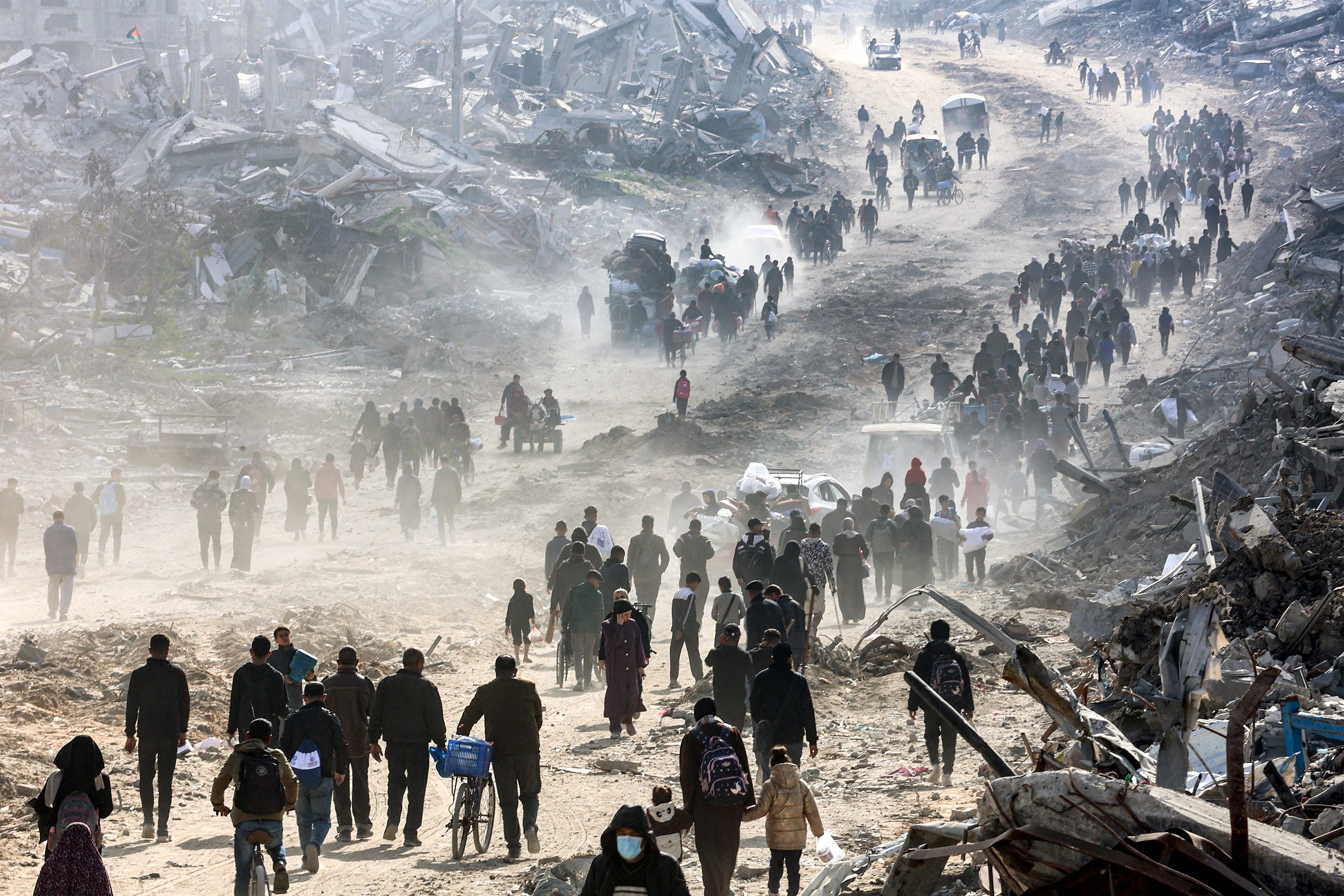
What happened to the people of Gaza who survived the genocide? Is it even right that we consider them survivors?

By Samar Yazbek
Samar Yazbek is a Syrian writer and journalist. Her novels Planet of Clay and Where the Wind Calls Home were both finalists for the National Book Award for translated literature, in 2021 and 2024. She is also the author of two acclaimed nonfiction accounts of Syria’s war: A Woman in the Crossfire: Diaries of the Syrian Revolution and The Crossing: My Journey to the Shattered Heart of Syria. Her work has been translated into more than twenty languages. She is the author of the new book Your Presence Is a Danger to Your Life: Voices of Survival and Witness in Gaza, from which this essay is adapted.
It is noon. I pause, resisting the haziness of vision that transforms the stone buildings into white arms trembling in the breeze, then continue moving along the wide avenue, trying to seek shelter from the burning midday sun. A few seconds later, I open my eyes as wide as they can go. I stare at the end of the street where black silhouettes are coming closer, moving oddly, shapes with uncertain features that blur and vanish into the mirage as if flying. I try to bring them into focus, struggling to grasp what is happening at the end of this unfamiliar road.
At the time, I wasn’t very familiar with this place. The map of the area was an enigma, and my sense of what was happening there was confused. I found myself, as intended, at a government office in Thumama. There, survivors of the Gazan genocide were gathered; people with amputated limbs in complex and critical states of health. Together with the family members caring for them, they numbered more than 2,500. This fantastical scene was taking place in a quiet city called Doha, but in those moments, the destruction in Syria was re-enacted for me. The silhouettes of the victims, the very same moans—it was disaster, all over again.
There wasn’t a living soul around. The cruel, oozing midday sun was burning my forehead, and strange qualms began to wrestle me in the desert noon. I looked away at first, trying to escape the thoughts taking hold, but then took a few steps closer, trying to distinguish those black shadows, and realized they were wheelchairs being pushed by others. I turned around, only to see a woman in black pushing a chair that carried a young woman in the prime of life. It occurred to me that the whole world had come to this: missing body parts, people with amputated limbs, half-bodies living on the margins of life like remnants of a bygone age. I felt like we were on board a ship hovering in mid-air, suspended within a destiny of impotence and loss, among delusions and ghosts I couldn’t quite make out. The sun was pitiless, and I had to head to the administrative offices to meet some officials. A train of thought transformed what I was seeing into an image from a novel, an attempt to maintain my equilibrium in the face of this reality. And to drive from my mind the interwoven scenes of ruin, the confusion between which was Syria and which Palestine.
The destruction in Syria was re-enacted for me. The silhouettes of the victims, the very same moans—it was disaster, all over again.
A strange grief nearly swallowed up the spectacle, as if the place was rendered unreal by the excess of its tragedy. Who can bear such agony?
It was no coincidence that I saw the devastation conveyed by these wheelchairs, so like flocks of black birds and carrying the resounding suffering of the Palestinian people—a people plucked out by the root and left to dangle in limitless space. Those phantoms embodied a recurring symbol of humanity’s defeat, as if Palestinians had become Syrians and Syrians Palestinians, across a shared space of brutality that I have witnessed, written about and buried in my heart.
I found myself facing those wheelchairs and the people who had survived the torments of genocide, impelled to try to understand their pain. I felt called upon as a writer trading in words and narrative as a means of empathy, of effecting change and, most crucially, of understanding the dangerous world around us, thinking of a better, more humane future. I was still panting in the wake of these racing thoughts, still drawn toward these people by the ideas so deeply rooted within me.
These people meant a great deal to me. One way or another, Syria was before me at that moment and, as always, I held fast to the imperative of not leaving the victims alone, the imperative of movement and action and feeling; these are the conditions of our existence, and by necessity our humanity.
I was stuck, suddenly, by a searing question—what happened to the people of Gaza who survived the genocide? Is it even right that we consider them survivors? Where does human pain go when justice is absent? How did they lose parts of their bodies and embark on new forms of existence? How can we deal with their sufferings? How can it be that the lives of ordinary people, having dwelled for years in an open prison, have vanished forever since that infamous day, on October 7? There is something else in the speed of this disappearance—destruction and a redoubled, unfathomable barbarity have settled over these people. Why do we drone on and on about their issues in political and ideological slogans, far removed from their subjective, individual pain?
These questions were troubling, but I did my best to collect myself that desert afternoon as I walked toward them. I said a greeting, and received some weak smiles and diffident glances in reply. Instantly, I realized that I was going to stay here. I was going to live among them, try to grasp the details of their lives and sit by their side with their grief—the grief that has made me come to recognize them as heroes and honorable people who resist so as to stay alive.
Why have I come back to writing about war? Once again, memory returns, more insistent than ever.
Between doubt and certainty lies the narrative of truth. We must approach language’s shadows and ghosts, we must listen to the voices of the victims. Now, precisely, language needs to bend beneath this rope pulled taut over our souls, a rope which overwhelms the mind’s capacity to fathom the curses that have settled over our countries. What should we do with these terrifying stories? Can the language of silence provide a way out of these desperate circumstances? Between blood-smeared facts, it is perhaps language’s transformation into silence that reveals our periodic failure to approximate atrocities. Yes; humans are capable of brutalizing each other, in ways that challenge language’s very capacity of expression.
We find ourselves adrift in the face of the transformations that genocidal wars impose on meaning and language, after the destruction of people.
For years, I have been attempting and thinking of new ways to rewrite and reinforce stories of the people and places we have come from. It is an attempt at reconstruction, extending beyond literature and documentation to reveal a different narrative, one that explores the pain and overwhelming catastrophe in our world. Now more than ever, this devastation writes our world in its own way: in pictures and numbers which erase it from humanity’s collective conscience, turning it into a momentary consumer product and causing fundamental meanings to disappear within the fetid decay of the immediate moment.
And so, we find ourselves adrift in the face of the transformations that genocidal wars impose on meaning and language, after the destruction of people. We are the offspring of war and tragedy, discussing horrors and humanity’s ability to destroy the world through sheer evil. On the other hand, we also possess the capacity to see the moment of destruction, to face it and work to overcome it, even from within catastrophe itself. There are those who no longer see any meaning to life, of course. And there are those who now concentrate the meaning of their lives on the memory of those who have left them, the loved ones who are so greatly missed. Violence can be neither described nor believed, to the point that we are powerless to narrate it. But these survivors are here; despite everything, they are living, in every sense of the word—with their questions, with their wish to understand what has happened to them, with their inability to understand. They are people who have passed through hell and returned.
We have a tendency to sanctify the agony of victims, but in one way or another they made me feel that they needed no sympathy. The people of Gaza don’t need our pity, but our acknowledgment of their bravery, their dignity and their rights, and their urgent wish to disclose the truth of their tragedy.
Excerpted from Your Presence Is a Danger to Your Life by Samar Yazbek and translated by Leri Price, published by Other Press on August 18, 2026. Copyright © Samar Yazbek and translated by Leri Price. Reprinted by permission of Other Press.


