

'Ritaj Rihan': A New Poem on Gaza
She went on her own two feet / and she came back to me on a stretcher.
By Vaheed Ramazani
Vaheed Ramazani is Professor Emeritus of French Literature at Tulane University, where he held the Katherine B. Gore Chair in French Studies. He is the author of three books, most recently Rhetoric, Fantasy, and the War on Terror (Routledge, 2021).
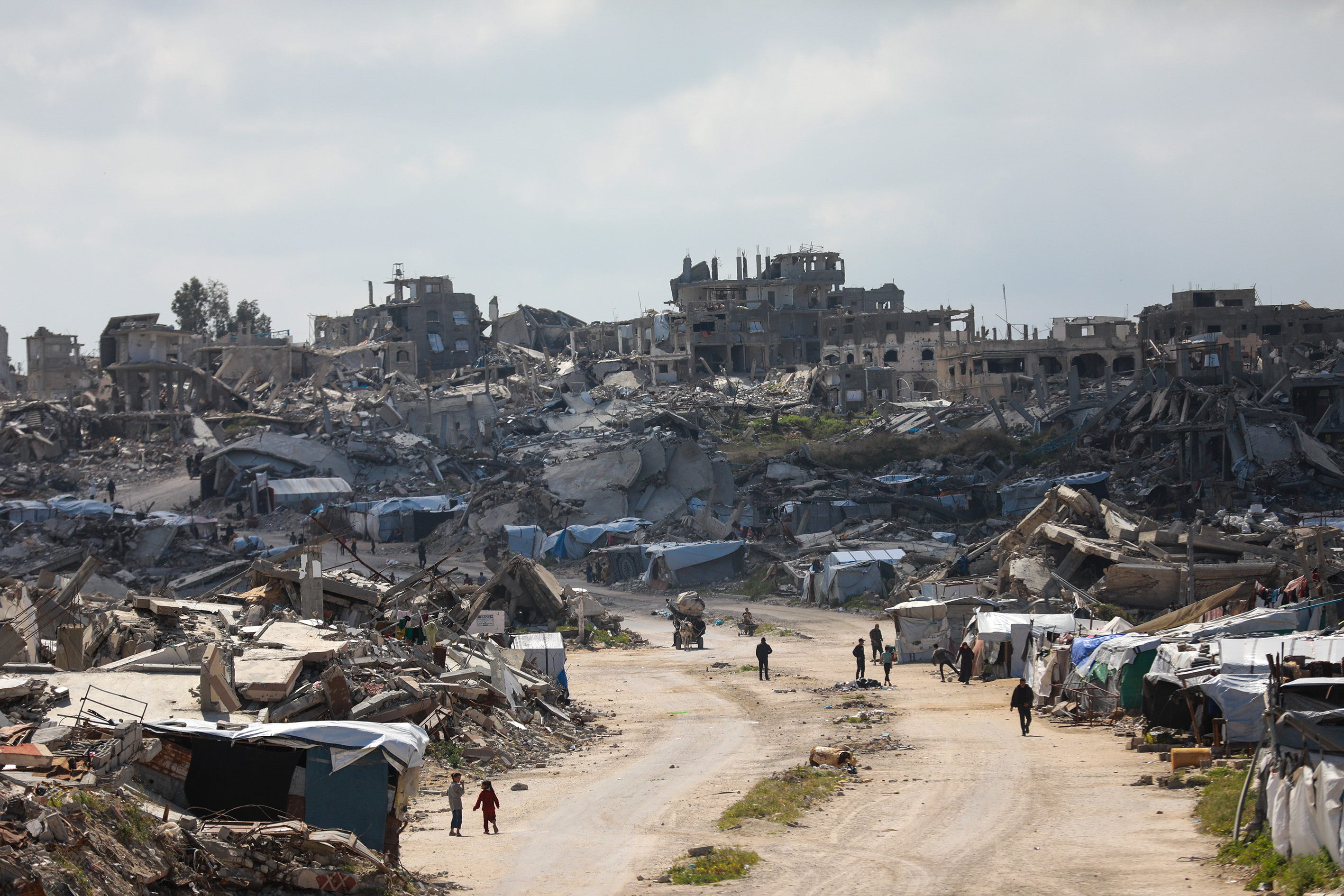
Editor’s note: More than 700 Palestinians have been killed by Israeli forces since a ceasefire took effect in Gaza last fall. Under the ceasefire, Israel still occupies more than half of Gaza, which has been split in two as part of President Donald Trump’s “peace plan,” divided by a “Yellow Line” that the Israeli military has enforced as a “free-fire zone” and Gaza’s de facto new border. On one side of the Yellow Line, more than two million Palestinians—virtually Gaza’s entire population—are confined to a narrow area along the Mediterranean, a ruined landscape of bombed-out buildings and makeshift tent cities. On the other, Israeli-controlled side of the line, Palestinians have been driven out and large areas have been demolished, building by building. All of Gaza’s fertile agricultural land lies on the Israeli-controlled side of the Yellow Line, in what looks more like annexation.
"Ritaj Rihan"

In early April 2026, roughly six months
after Israel and Hamas declared a ceasefire,
Ritaj Rihan,
a nine-year-old Palestinian girl,
was shot dead
while attending class
in a school tent
two kilometers from the yellow line
where Israeli troops were stationed.

She was shot in the mouth
and died instantly.

“The girl was holding her notebook and had her backpack,”
said Ayman Rihan, a teacher at the school.

“She was writing
inside the classroom,
inside the school,
inside a space where all the students feel safe.

Every day children like this are killed—innocent children.
What was her crime?
Was she carrying a Kalashnikov?
Was she carrying a rocket?
Was she carrying ammunition?
She was carrying her schoolbag on her shoulders.”

In the morgue of Al-Shifa hospital,
Ritaj’s body
lies draped in a blue cloth
topped by her blood-stained jacket and sweater.

Her long auburn hair
flows out from beneath the cloth
and over the edge of the table.
The bullet that took her life
sits on the table
next to her head.

Inside a tent in Beit Lahia,
Ritaj’s mother sits mourning, clutching
her daughter’s blood-spattered notebook.

“Ritaj is everything to me. Ritaj is a piece of my heart,” she says.
“She went on her own two feet
and she came back to me on a stretcher.”

As she weeps, the relentless hum of Israeli drones fills the air.