Returning to Syria's Sea of Rubble
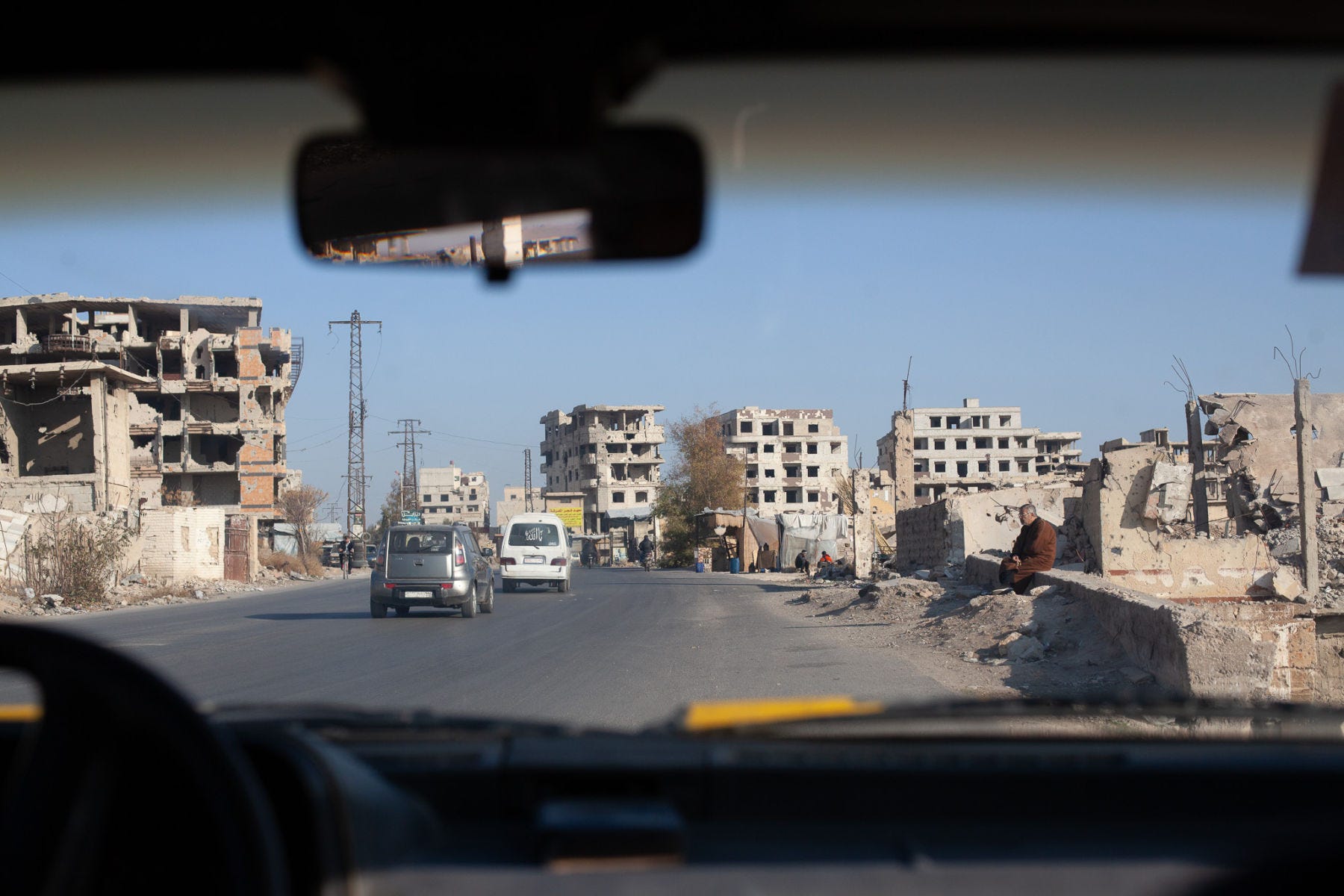
The ruins stretched for mile after mile. We drove on over dust to what had once been the suburbs of Damascus.

By Robin Yassin-Kassab
Robin Yassin-Kassab is a British Syrian writer and journalist and the author of The Blood Between Us: Syria After the Fall of Assad, recently published by Saqi Books.
God knows, there is a lot of building to do.
The old frontline in Damascus lay just after Abbassiyeen Square, which is really quite central, not far from Bab Touma in the Old City. After the square comes Abbassiyeen Stadium, which the Assad regime at one point used as a detention and torture center.
Just a couple of hundred meters further on, the rubble begins. This area is Jobar, held by the rebels for years and therefore bombed for years by Assad, the Iranian militias, and Russia. I and my wife were driven through Jobar during the post-Ramadan Eid, when local people were returning to the ruins to attend their relatives’ graves. They picked between shattered and overturned gravestones surrounded by shattered and overturned buildings. It was necessary to watch where we stepped very carefully, not only for the risk of unexploded ordnance, or to avoid stumbling on the broken breeze blocks, but because every so often, deep shafts opened in the ground. These were signs of the tunnel system built by the rebels that had allowed them to hold out for so long.
The rubble stretched for mile after mile. We drove on over dust to what had once been the suburb of Harasta. My cousin Mustafa had built a home and a dental clinic in Harasta. He now lives precariously—without permanent residence—in Germany, having fled Syria after arrest and extreme torture. His home and clinic were as impossible to find in Harasta as the past.
Opposite the flat in central Damascus that I had lived in 27 years ago, there was a working man’s restaurant called al-Tayabat. In those days, I would sometimes call down and across the narrow alley from my tiny kitchen balcony for a meal. “Ya Muhammad! Send me some fried liver, please!” Muhammad was a hardworking, gentle-eyed, softly-smiling man who performed his prayers behind the restaurant counter and invited me for tea and cigarettes after closing time. Once he knew me well enough, he told jokes mocking Hafez al-Assad. Muhammad had commuted to work from his home in Harasta. I checked for the restaurant when I looked for my old flat. No sign of it remained.
And no sign of anything much in Harasta, save the relics of a previous existence. The rusted shells of vehicles were three quarters buried in the earth. But young fig trees were emerging from the cracks. If the place were left as it is for another decade or so, it would turn into a forest of figs.
Someone had painted on an intact bit of wall the words Eid bil-eid n’amara min jadeed, or “Hand in Hand We’ll Build It Anew.”
These destroyed suburbs are in the Ghouta region, which not so long ago was mainly green, a great stretch of orchards and streams fanning out from the mountains before they dried up in the badia, the rocky Syrian Desert that extends to the Euphrates. This is the Ghouta, whose villages rose fiercely against the French occupation in the 1920s, and whose towns rose fiercely against the Assad tyranny from 2011 onwards.
There is a story that the Prophet, who came to Syria as a caravan trader before his prophetic mission began, refused to enter Damascus for fear that he would commit the sin of thinking himself in paradise before he actually arrived there. The story refers to the fabled beauty of the Ghouta that surrounded and penetrated the city. The area had already lost most of its greenery before 2011. Urban sprawl combined with corruption meant that much of the designated green belt was concreted over. Summertime temperatures increased as a result. But the counter-revolutionary war brought a higher order of vandalism. The area suffered day after day of barrel bombs, for years, along with heavy artillery shelling, cruise missiles, and incendiary weapons including white phosphorus and thermite. The people here were subjected to starvation sieges, and ended up eating dandelion leaves and dogs and cats to survive.
We continued through crumpled residential blocks and flat fields of rubble to the next ex-settlement, Irbeen. Some of these areas had been destroyed by bombing. Others had been destroyed first by bombs, and then bulldozed to make it entirely impossible for anyone to return. But someone had painted on an intact bit of wall the words Eid bil-eid n’amara min jadeed, or “Hand in Hand We’ll Build It Anew.”
There was almost nobody in these ruins. It was a stark contrast to the crammed busyness of the city center—the restaurants were full there because there were no restaurants out here. We drove on to Douma, where the buildings were more often semi-intact, if very scarred, and where more people were living. But the people were war-blasted. Men missing legs were propped on broken wheelchairs at roadside.
On another day we visited Yarmouk Camp, which 15 years ago had housed the biggest Palestinian community anywhere outside of Palestine. In the 1950s, it was a field of tents sheltering people driven from their homes in what is now northern Israel by Zionist militias, but over the decades, canvas was replaced by breeze block, people added storeys to their houses as their families grew, and the camp transformed into an inner city neighborhood. Twenty-seven years ago I had had friends here and knew the place pretty well, but that made no difference now. It was unrecognizable, and not only to me. My brother-in-law’s aunt also was unable to find her way around, though she had lived in Yarmouk for most of her life.
What was very obvious in the remains of Yarmouk was the organized looting practiced by the Assad regime. Once the residents had been bombed and starved out, regime operatives arrived in trucks to strip the ruins of everything that could possibly be taken: soft furnishings, sink units, copper pipes, electrical cables, bathroom tiles. Companies owned by the billionaire Muhammad Hamsho stole and repurposed the scrap metal. In this way, former urban areas were cannibalized as effectively as the economy. Plenty of planning went into this process. It was a master-class in de-development. Or even worse than that, because the regime wished not only to erase the progress that had been made, but to erase the entire population that had lived here. It was fully annihilationist. And it nearly succeeded.
But not quite. On one floor of one of the hollowed-out, monochrome, skeleton buildings of Yarmouk, someone had fitted new windows. In a few other buildings, families had claimed a space and a few meters of privacy by pinning a sheet across a blown-out wall. People are returning. More every day.
The World Bank’s “conservative best estimate” is that it will cost $216 billion to rebuild Syria’s basic infrastructure—that is, at least ten times more than 2025’s expected gross domestic product (GDP). In order to drive away the rebellious population, the Assad regime deliberately destroyed anything that could sustain it. In the regime’s last years, actual famine did not seem far away. The economy was in such bad shape that political economist Karam Shaar predicted during a talk in 2023 that if the regime were attacked by a group of 30,000 men, it would fall within days. “Nobody believed me!” he says now. I tell him that after the September 2024 assassination of Hassan Nasrallah, I posted on social media that it was a shame there was not an effective anti-Assad force to take the fight to the regime now it had no foreign props. I had not realized that Hay’at Tahrir al-Sham (HTS) had become that force, nor that the regime had no domestic props left either. I had not been paying enough attention.
The regime had built a house of sand. “Living conditions,” say Karam, “had not been as bad since the First World War. State employees were paid about 20 dollars a month. The state sector was teetering on the verge of collapse. Syria had become a narco-state, with Captagon”—an illegal, addictive amphetamine—“funding the militias that kept the regime in place.”
There have been some very wild estimates of the size of the Captagon business, reaching up to $60 billion annually. Karam thinks the regime’s Captagon revenue was more like $ 2 billion annually, which is still “more or less the size of the state budget, or twice as large as the country’s licit exports combined.”
Now industrial-scale production of the drug “has all but stopped.” Regional demand remains high, the absence of better options means the business still tempts many, and makeshift facilities still exist, but there is no political sponsorship now. On the contrary, the government and its security forces are working hard to eliminate the narcotics trade, both for Islamic reasons and to prove good neighborliness to nearby states.
When the rebels reached Damascus, they brought with them a less criminal and much more successful economic model. Idlib held the largest proportion of internally displaced people, most living in tents, so in terms of livelihoods it was no better off than Assad-controlled territory, but it was better in terms of competition, access to resources, economic acumen, and governance. It did better than the Syrian Democratic Forces-held northeast too, though it did not provide a perfectly level playing field for economic actors. Karam describes a “crony capitalism similar to that of the Gulf States, in which favored people feed, but the unfavored are not pushed out.”
In January 2025, the new authorities cancelled the contract Assad had granted to Russia allowing it to manage Tartous port. This and similar acts endeavored to undo the slave-master relationship which rebel commander Ahmad al-Dalati had complained about when he addressed the public in freshly-liberated Aleppo. But at the same time, the government announced plans to privatize key infrastructure, including ports. In May, it signed a 30-year, €230 million deal with French shipping giant CMA CGM to upgrade and expand Latakia port. In July, it signed another $800 million port development contract with the United Arab Emirates-based company DP World.
Revamping the ports is part of Syria’s reintegration into regional and global markets. In the first year after liberation, great progress has been made in areas including gas connectivity with Turkey and Azerbaijan, electrical connectivity with Jordan, an oil pipeline with Iraq, and Silk Link internet connectivity. There are also plans to re- launch the Hijaz Railway linking Turkey to Saudi Arabia via Syria. All this is very positive, and Syrians look forward to ending their isolation as a result of it. But some also worry about a capitalist free-for-all that could damage local industry and leave workers unprotected.
Some have suggested that the government’s initial pro-business, free market position was more diplomatic than anything else, part of the larger effort to assure regional and Western states that they had nothing to fear from the new Syria. But Karam Shaar says it was absolutely genuine, though it is only the very upper echelons of the government, including al-Sharaa himself, who really believe in “extreme deregulation, a very lean state, a libertarian laissez-faire approach ... and [al-Sharaa] is now facing stiff resistance from state institutions and the experts he’s brought in to work on the economy.” Even al-Sharaa’s economist father, Hussein, publicly criticized the privatization agenda, declaring the state sector a “national asset built over decades,” and saying that “the issue is not with the public sector itself, but with the mismanagement that has plagued it.”
“Socialism” has a bad name in many Syrian quarters because it is what the Assad regime claimed to practice. “Unity, freedom, socialism” remained a key Baathist slogan well into the neoliberal phase. Though Syria’s poor did benefit from subsidized food and fuel (only very slightly subsidized by the end), the overall economy suffered greatly from top-down, and thoroughly corrupt, bureaucratic mismanagement. Add to that the fact that most Syrian businesses are small family-run workshops rather than large factories where hundreds of workers gather, and that trades unions were very closely controlled by the state, and one can understand why many Syrians may wish for a fresh free-market start. Yet the reality is that Syria’s ravaged economy and infrastructure are not at all capable of competition with the cheap Turkish and Chinese goods now flooding the domestic market.
Karam believes the original al-Sharaa approach is “very much not what the country needs ... Al-Sharaa believes in a world in which the ‘selectorate’ includes the military leaders and the main business tycoons, and the rest just don’t matter.” Though this approach is not what Syria needs, “that’s how you stay in power, not by broadening the winning coalition, but by keeping it narrow, so the rest don’t even have a voice.”
Here again, that contradiction arises between the needs of the people to heal and rebuild and the needs of those in power to consolidate power.
Robin Yassin-Kassab is also the author, with Leila al-Shami, of Burning Country: Syrians in Revolution and War, which was shortlisted for the Folio Prize, as well as the novel The Road From Damascus. He has written for The Guardian, Foreign Policy, and other publications, and appears regularly on the BBC, Channel 4, and Al Jazeera. Yassin-Kassab is currently the English editor of the Prisons Museum, an NGO that documents and investigates detention facilities in Syria run by both ISIS and the Assad regime.
Editor’s note: This essay is adapted from The Blood Between Us: Syria After the Fall of Assad by Robin Yassin-Kassab, recently published by Saqi Books.


