

King Abdullah’s False Promises of Reform in Jordan
The Western-backed monarch’s purported commitment to political liberalization doesn't match reality for Jordanians under his long rule.
By Aaron Magid
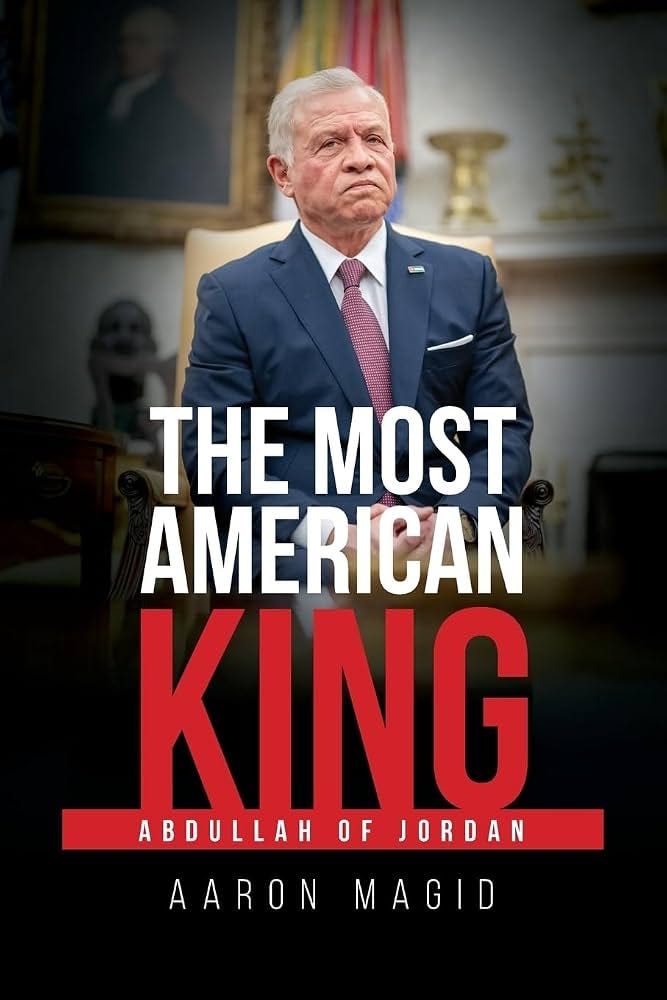
Aaron Magid is a former Amman-based journalist who has written for Foreign Affairs, Foreign Policy, and Al-Monitor. He is the author of The Most American King: Abdullah of Jordan, from which this essay is adapted.
In the days before he ascended to the throne in Jordan more than 25 years ago, King Abdullah II cautioned against rapid liberalization of the country’s political system. “Democracy is not something that can be done overnight,” Abdullah told reporters in early February 1999, just before the death of his father, King Hussein. Abdullah sought to emulate Hussein’s decades-long rule over the small desert kingdom, where the Hashemite dynasty was installed by the British in 1921 in what was then the Emirate of Transjordan.
Yet, during Abdullah’s first months on the throne, the new king—who had attended boarding school in the United States and immersed himself in American culture—expressed some interest in political reform efforts. In May 1999, Abdullah told ABC News that he sought to continue his father’s path of “democratic reforms.” Hussein’s own record on democratization, though, was mixed. He imposed martial law for over a decade following the 1967 Arab-Israeli War and prohibited large gatherings. After widespread protests in 1989 over a rise in food prices, Hussein allowed parliamentary elections in Jordan for the first time in 22 years. The 1989 elections were considered one of the freest in the kingdom’s history and resulted in the Muslim Brotherhood winning the parliamentary speaker post. However, Hussein reversed course by cracking down on civil society, particularly after Jordan’s 1994 peace treaty with Israel, which engendered considerable domestic opposition.
While acknowledging that regional conflicts may impact Jordan’s advancements, Abdullah said in May 1999, a few months into his reign: “The sky is the limit for what can be done on, on democracy and democratic reforms.” Even as the king criticized some journalists for “creating animosities” between countries, he also pledged to quickly end censorship in the Jordanian media. Without offering any clear deadline on when he wished to achieve genuine democracy, Abdullah suggested—at least to a Western audience—that he was eventually interested in heading down the path of political liberalization.
That path, however, has not led to actual reform but instead to a series of touted royal committees repeatedly convened by Abdullah throughout his rule—in 2002, 2005, 2011, and 2021—all promising a strong parliament and democratization, and which all then failed to follow through. Each time, he promised to finally reform Jordan’s political system that denied citizens genuine representation and privileged the monarchy above all else. However, no such change has occurred after all those years.
While Abdullah enthusiastically promoted Jordanian political participation, his actions on the ground showed a different picture.
Abdullah’s appointment of these numerous royal panels designed to address political reform was paradoxical. On the one hand, the many government committees ensured that during each decade on the throne, the king publicly worked to liberalize Jordanian politics. Such efforts produced considerable noise. The king convened experts and tasked them with compiling lengthy reports, often leading to animated public debate on the role of political parties. Nonetheless, after a quarter century of Abdullah in power, all of these efforts have brought little tangible change.
Parliament remains weak with the king and security forces dominating Jordan’s decision-making. It is almost like the Hashemite Kingdom was riding a bicycle in place. The king’s management of Jordan’s Cabinet operated in a similar manner. Fifteen prime ministers have served under Abdullah, averaging less than 1.5 years per premier. Even within a single prime minister’s term, Abdullah has frequently reshuffled the Cabinet, dismissing some of the ministers. As with the royal committees, the firing of so many prime ministers generated considerable public attention. Dozens of articles have been written in the local press about the changing officials. Ultimately, the many ministerial dismissals maintain the status quo power structure as Abdullah cannot be fired by any other government official.
The king has continued to maintain the sole power to appoint and fire prime ministers. Abdullah was never elected and even poll questions asking Jordanian citizens about his popularity are prohibited. While the Jordanian public elects the country’s lower house of parliament, Abdullah selects every member of the Senate. No bill can become law until the approval of both houses, including the one Abdullah fully appoints.
While Abdullah enthusiastically promoted Jordanian political participation, his actions on the ground showed a different picture. Security forces detained dozens of political activists in March 2022 ahead of the anniversary of a key Arab Spring protest. Not content with stopping the protests on the streets of Jordan, the regime detained the activists while they were still at home to ensure that protests could not even begin. Security forces even arrested 87-year-old activist Sufian al-Tel from his home in Amman for criticizing government policy. The United Nations warned that Jordan’s arrest campaign and crackdown appeared to be “part of a deliberate campaign to silence dissent.” The international criticism continued with Human Rights Watch issuing a damning report on how the Jordanian government “crushes civic space.” It noted that in 2020 alone, there were over 300 registered Jordanian court cases for “lengthening the tongue” against the king (lèse-majesté, as is known in French, or insulting the king). According to Human Rights Watch, “The authorities detain, interrogate, and harass journalists, political activists ... and their family members, and restrict their access to basic rights such as work and travel, to quash political dissent.”
The gap between Abdullah’s grand rhetoric on a free press and on-the-ground challenges for journalists has been stark. During the early years of his reign, in 2001, Abdullah expressed pride in calling for Jordan’s Information Ministry to be disbanded. The king told the BBC that abolishing this government office, which was responsible for overseeing the press, would boost media freedoms and showed Jordan was a step ahead of many countries across the Middle East. Despite Abdullah touting the ministry’s closure, Jordan soon established a Ministry of State for Media Affairs in its place—which had a similar objective as the former Information Ministry and maintained the powers of appointing the director of state-run Petra News and Jordan TV. In 2007, Abdullah asserted that there would be “no restrictions on press freedoms in the kingdom.”
“He never believed in political reform at all. He paid lip service.”
Despite the king’s pledge, journalists in the country have continued to face harassment throughout his rule. It is true that Jordan’s treatment of the press has been better than neighboring Iraq and Syria, where armed groups have killed reporters. At the same time, Reporters Without Borders recently ranked Jordan 147 out of 180 countries surveyed in its World Press Freedom Index, noting that “journalists are subject to close surveillance by the intelligence agencies ... [and] are subjected to additional pressure in the form of frequent interrogations.” A local poll in 2022 showed that 93 percent of Jordanian reporters engage in self-censorship due to fear of government pressure. Security forces have repeatedly jailed journalists for critiquing government policy. In 2023, journalist Heba Abu Taha was detained for rebuking Abdullah over normalization with Israel, and influential satirist Ahmad Hassan Zoubi was sentenced to a year in prison over a social media post assailing the government’s response to protests in southern Jordan.
Abdullah’s purported commitment to political reform and democratic values were further tested in 2023 with parliament’s passage of a new cybercrime law. The measure increased restrictions on online speech with ambiguous provisions criminalizing “fake news” and “undermining national unity.” The legislation also held Jordanians accountable for comments written by other individuals on their social media posts that the government considered illegal. Even liking a problematic Facebook post could leave citizens open to prosecution.
“They want Jordan’s media silent [just as in] any other Arab autocratic state,” explained Nidal Mansour, director of the Amman-based Center for Defending Freedom of Journalists. The measure, which amended a 2015 cybercrime law, threatened to throttle social media platforms that fail to comply with the new Jordanian government regulations. Authorities said the law was necessary to protect citizens’ privacy and punish blackmailers. On Jordanian social media, the Arabic hashtags #the_cyber_crime_law_ is_against_the_king’s_vision and #the_king_is_the_protector_of_freedoms trended in a bid to encourage Abdullah not to sign the controversial bill, as required for it to become law. “If this law is passed, it would be a legislative disgrace,” former lawmaker Rula Hroob wrote. “Your Majesty, we kindly ask that you return it. We hope that you will prevail for the constitution, our legal system, and our freedoms.” Nonetheless, Abdullah ignored Jordanian human rights activists’ pleas and signed the cybercrime law within weeks of its passage.
“He never believed in political reform at all. He paid lip service,” charged Labib Kamhawi, an Amman-based Jordanian political analyst. “People have become frustrated because the king is doing anything that he wants. The king is amassing all powers in his hands.”