
Alex Simon is a researcher, writer, and co-founder of Synaps, a Beirut-based research and training center that conducts intensive fieldwork on socioeconomic trends in the Middle East. From 2017 to 2024, he coordinated Synaps’ team of Syrian researchers working across Syria and neighboring countries. He is the editor of Syrians in the Shadow of War: Everyday Struggles and Survival, recently published by AUC Press and from which this essay is adapted.
Much has changed since the fall of Bashar al-Assad’s regime, and much has not. The challenges Syria now faces, and the resources it brings to bear in tackling them, are years and decades in the making. A starting point is to reckon with that legacy: What has been lost, and what has been built? What traditions must be preserved or revived, and what familiar mistakes must be avoided? Today, more than at any point in over half a century, Syria can debate those questions on its own terms, on its own turf.
Cross the border from Lebanon, and Syria’s transformation is instantly apparent. Bashar al-Assad’s face, once ubiquitous, has been ripped from posters and scratched from walls. Some roadside check-points are abandoned and graffitied, others manned by men with beards, weapons, and mismatched uniforms—or no uniforms at all. They are strikingly polite and often confused by their own border policies, which have changed continually throughout the transition. Equally polite are the passport control agents tasked with applying these policies to journalists, aid workers, Syrian diaspora, tourists, foreign officials, and beyond. Perhaps most striking of all is that, for now at least, the new authorities have tamped down the petty corruption that was rife just months before.
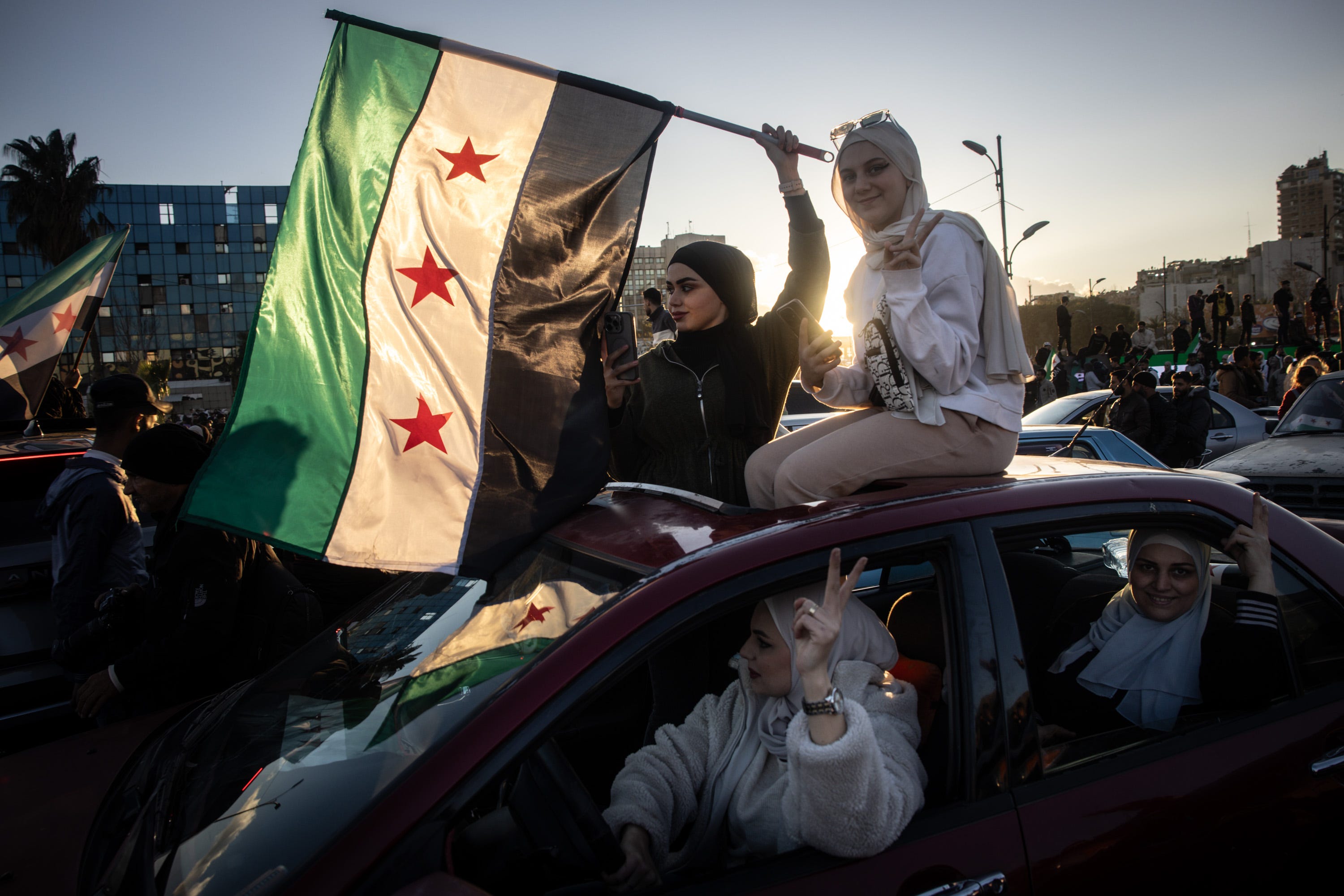
Since Assad’s fall in December 2024, transformation has been etched into the streets of Damascus. In the transition’s early months, the capital choked with traffic and car exhaust. The new authorities had dismissed the traffic police, leaving Damascus particularly ill-equipped to cope with an influx of people, from the conquering forces who swept into the capital to displaced people returning home. Locals also noted a surge in tourists from elsewhere in Syria, pointing to the diversity of license plates, dress codes, and accents. In February 2025, a young Syrian man strolled into a corner store and asked for the price of a bottle of water . . . in Turkish pounds. An older man, this one from a venerable Damascene family, remarked on the influx with at least a hint of pride: “Damascus is unlike anywhere else in Syria. People want to come see it, especially if they couldn’t before.” His brother noted that he had lately visited the Old City’s famed hammam and found all the other customers were Syrian tourists—an improvement, in his view, from the days when it was always packed with Iraqi militiamen.
As international support remains scarce, Syrians will keep doing what they have done for years: Managing, as best they can, from one day to the next.
Change is equally visible on the capital’s outskirts. Twenty minutes’ drive north, through the mountains flanking Damascus, sits al-Tal: a staunchly pro-revolution town that suffered years of siege before a 2016 ceasefire. Within weeks of Bashar al-Assad’s fall, visitors were greeted by freshly painted murals and signs bearing inspirational slogans: Smile, you’re in al-Tal; #KeepGoing. The most prominent were plastered on the façade of the town’s public school, which overlooks a central intersection formerly clogged by a checkpoint. The latter was manned by the mukhabarat’s Political Security branch, which harassed residents and swept away those wanted for detention or conscription. No trace of the checkpoint remains, after locals moved fast to reclaim their environment. That mobilization reflects the intellectual and activist bent in a town long known for its university. Al-Tal also benefits from a steady stream of remittances from expats in the Gulf—a form of support immediately visible in the ubiquitous solar panels crowding the town’s rooftops.
A grimmer picture awaits on the other side of Damascus, in the ravaged suburb of Darayya. Like al-Tal, Darayya endured years of siege and bombardment before striking its own 2016 surrender deal. But Darayya suffered far greater levels of destruction and depopulation, thanks to its position just eight kilometers from central Damascus—and closer still to the al-Mazzeh Military Airport. Much of the town lies in ruins; some buildings are standing but damaged beyond repair, while others were systematically looted and blown up by conquering regime forces. Even here, though, change is visible. Displaced locals have trickled back from northern Syria to survey their homes and probe avenues for recovery. Some congregate in a sparsely furnished but freshly painted community center.
As the shock of December 8 subsides, Syrians are also taking stock of how much the new Syria has inherited from the old one. Some joke about the similarities between the fallen regime and its replacement: Like Bashar al-Assad, they note, Interim President Ahmed al-Sharaa is tall, has a brother named Maher, and a wife whose family is from Homs. A key difference, they concede, is that Assad is a doctor and Sharaa is not—although his brother Maher is. More seriously, they worry that Syria’s new leader, like its old one, has invested far more in courting international supporters than in building bridges to Syrians who fear this new order.
Of course, the continuities go beyond the presidential palace. Among the most threatening is the continued breakdown of public services. Fuel, bread, and bus prices have soared. Law and order have deteriorated, and with them freedom of movement in insecure areas. Kidnappings have multiplied, along with stories of anonymous gunmen impersonating security forces in order to rob or intimidate. Communities targeted by sectarian violence—Druze in Sweida and the Damascus suburbs, Alawis from Damascus to Homs to Latakia—protest that they have received neither justice nor security.
Parallels don’t end there. The caretaker authorities have pitched themselves, both domestically and abroad, as a free-market alternative to Syria’s “socialist” regime. This ignores that Syria’s economy had already transitioned, since the 1990s, toward privatization and crony capitalism. It also sounds much like Bashar al-Assad’s promises, upon assuming office in 2000, to open up Syria’s economy to international markets. This neoliberal pitch appealed to both Western leaders and Western media, who hailed Bashar as a modernizer.
Whatever one thinks of the interim government’s economic approach, a more fundamental problem is that Syria is broke and the international community shows little appetite to help. While Syrians have rightly celebrated the loosening of American and European sanctions, such relief is no substitute for serious reconstruction aid. The latter is scarce and disjointed, coming through in bits and pieces: an injection of Qatari gas, a Saudi–Qatari handout to settle Syria’s 15.5-million-dollar World Bank debt, a 146-million-dollar World Bank loan to rehabilitate electrical infrastructure. All much needed, to be sure, but barely a starting point after a conflict whose price tag is estimated in the hundreds of billions of dollars.
Syria has, today more than at any point since the birth of its police state in 1958, the space to call its problems what they are and argue over their solutions.
For all the foreign meddling that shaped Syria’s trajectory since 2011, the transition has been a decidedly Syrian affair. The rebel forces who swept into Aleppo, Hama, Homs, and Damascus were Syrian through and through—notwithstanding a smattering of foreign fighters and a presumed greenlight from Ankara. The regime’s collapse resulted not from foreign intervention, but its opposite: Israel’s gutting of the Lebanese Hezbollah stripped Syria’s regime of an essential ally. When rebels seized the moment with an offensive of their own, Damascus’ other main backers—Iran and Russia—stood aside.
In the months since, foreign states have done little to steer the transition. Apart from welcome progress on sanctions relief, frenetic diplomacy has yielded little progress in the areas that would matter most: to include transitional justice, reconstruction aid, and reviving state institutions. In many respects, the international community is doing more to spoil Syria’s transition than to enable it. Israel and Turkey bomb military and civilian infrastructure with tacit American and European support; slashed aid budgets keep Syrians stuck in survival mode; Middle Eastern and European states scapegoat Syrian refugees rather than helping them chart a path to recovery and perhaps, eventually, return.
Much the same is true in the field of knowledge production. After more than a decade of struggling to access Syria, international media have yet to capitalize on the unprecedented space afforded by the new order. Cash-strapped and jerked between competing global crises, many foreign outlets cover the new Syria much as they covered the old one: dipping in and out on missions, focusing on Damascus, granting too much space to official statements and not enough to farmers and pastoralists, teachers and students, the doctors and the disabled.
In virtually every respect, then, this phase in Syria’s journey will be defined by Syrians. The most rooted and granular documentation comes from Syrian activists, media outfits, and civic organizations. The country’s new leadership will continue to make mistakes, not least that of directing too much of its energy at courting foreign powers and not enough building bridges to its own people. Syrians will probe ways of holding it accountable, some of which will succeed while others will fail. As international support remains scarce, Syrians will keep doing what they have done for years: Managing, as best they can, from one day to the next; finding ways to help themselves and each other, despite also hurting each other; and rebuilding, slowly and incompletely, one small business and apartment block at a time.
What emerges will not be the Syria of 2010. For the foreseeable future, at least, it will have less wealth, worse services, fewer citizens, and more trauma. But it also has, today more than at any point since the birth of Syria’s police state in 1958, the space to call its problems what they are and argue over their solutions. What comes next is any-one’s guess, but this alone is revolutionary.


