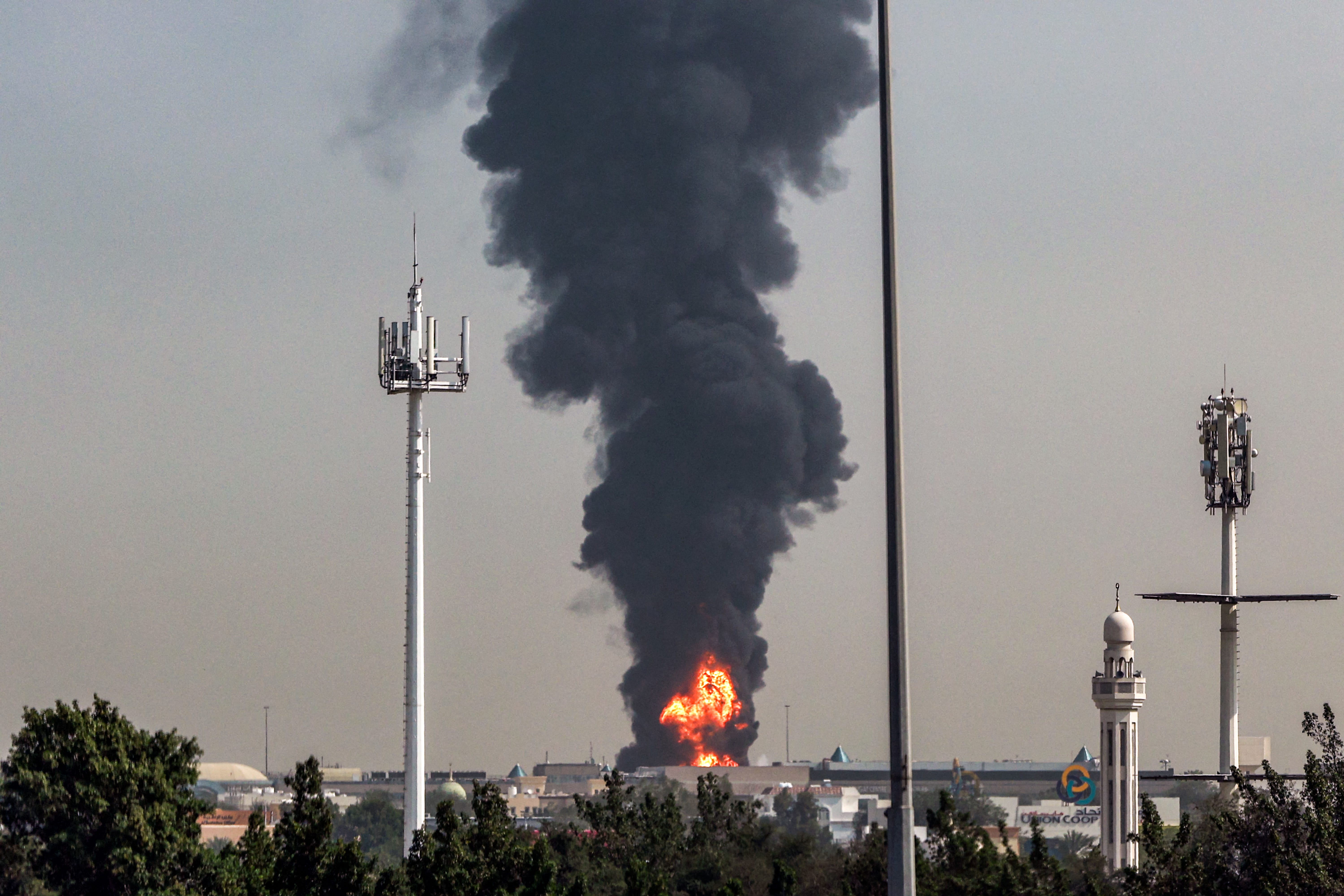
How the Iran War Shattered the Gulf's Illusions of Stability
The image of a well-heeled safe haven is hard to reconcile with air raid sirens and sudden explosions of missiles and drones.

The following is an excerpt from my new piece in World Politics Review, published earlier this week. Read the full piece via this gift link.
Across the six member states of the Gulf Cooperation Council (GCC), governments have strictly controlled information about the Iran war, in the hope of projecting an image of remaining on its periphery. Amnesty International recently accused authorities in the GCC of “indiscriminately criminalizing the exchange of information” under the pretext of national security, with “blanket warnings” across the Gulf “banning content deemed to spread ‘rumors’ or draw on ‘unknown sources.’” Essentially, that means any video or image of Iranian missile or drone strikes, or even debris from the region’s vaunted missile defense systems.
In the United Arab Emirates, Qatar, Bahrain and Kuwait, government officials have publicly announced the arrests of hundreds of people for violating those restrictions—nearly 400 people in the UAE alone, including dozens of British nationals, and more than 300 people in Qatar. As Amnesty noted, in Dubai, police have conducted “door-to-door phone inspections in areas affected by drone strikes,” with some foreign nationals reportedly arrested for sharing photos of their apartment buildings hit by an Iranian drone.
“These governments are exploiting the escalation in regional tensions to intensify their already suffocating grip on freedom of expression, in order to protect their pristine image as safe havens,” according to Heba Morayef, Amnesty’s regional director for the Middle East and North Africa. But instead of instilling a sense of stability, what Morayef called a “stranglehold on information” has led to mass confusion and a climate of fear. “Since the war began,” she said in a statement, “the public information released by Gulf states has been extremely limited with states seeking to control the narrative about the impact of Iranian attacks on daily life.”
But the information clampdown, which in the UAE has led to authorities detaining some of the very social media influencers they once cultivated as brand ambassadors for the good life in Dubai or Abu Dhabi, reveals more about the unease of Gulf monarchies over events beyond their control. “The crackdowns should be seen less as a show of strength than as a symptom of weakness,” scholars Frederic Wehrey and Charles H. Johnson wrote recently. “Rulers who have spent decades cultivating an image of stable modernity are now criminalizing the act of shattering that image.” As they also noted, “the arrests expose the fragility of what passes for a social contract in the Gulf—a bargain of acquiescence in exchange for prosperity and security.”
Media outlets across the region are helping to maintain that fragile social contract by parroting the official line, and then some. The National, a state-owned, English-language newspaper in Abu Dhabi that once boasted of its autonomy from the Emirati government, justified the UAE’s information restrictions in one op-ed—euphemistically described as “wartime social media measures”—as “an effort to preserve order, stability and public confidence” in the name of “civil defense and national resilience.” Another National op-ed extolled “a certain mettle in the UAE’s DNA,” declaring that “courage, clarity of thought, unity and action are all parts of the complex lines of code that constitute the UAE’s foundation story.”
But even a full media blackout could not hide the war’s harsh realities, even as Gulf states try to maintain an image of normalcy. By any metric, the war has had a devastating impact on the GCC. The closure of the Strait of Hormuz has choked off exports of oil and gas that fuel the Gulf’s energy-driven economies. In Bahrain, Kuwait and Qatar, oil and gas exports have all but stopped. The UAE has fared better, with its oil exports only falling by half, thanks largely to a pipeline running to the Gulf of Oman that bypasses Hormuz. The biggest beneficiary may be Saudi Arabia, with ports on the Red Sea and its own pipelines connecting them with oil fields along the Gulf. Saudi oil exports have only dropped by roughly one-third, according to The Economist, while the profits of the state oil company, ARAMCO, have jumped with the oil price shock.
“Rulers who have spent decades cultivating an image of stable modernity are now criminalizing the act of shattering that image.”
Iranian strikes have also damaged key oil and gas infrastructure, while disrupting air travel at some of the world’s busiest airports. Images of drones or debris hitting high-rise apartment and office towers have driven tourists away and risk an exodus of the expat workforce on which cities like Dubai were built. As scholar Dalia Ghanem told me, “The Gulf model is uniquely dependent on the psychological confidence of two highly mobile, risk-averse groups: international energy markets and the global expatriate talent pool that comprises the backbone of its professional sectors.”
As ever, migrant workers, who account for just over half of the total population in all GCC countries, have suffered worse on the fringes of Gulf society. The overwhelming majority of civilian deaths across the Gulf have been migrant workers, with at least 24 killed in the war, according to the Coalition for Labor Justice for Migrants in the Gulf, an advocacy group. They also face “additional risks to both their lives and their socioeconomic rights” beyond the usual abuses of the Gulf’s kafala system for migrant laborers, according to Human Rights Watch.
In Bahrain, migrant workers—who make up three-quarters of the private labor force—have been excluded from the government’s emergency wage support program. As Michael Page, the deputy Middle East and North Africa director at Human Rights Watch, warned, “Bahraini authorities are essentially stealing salary contributions migrant workers have made by denying them access to this emergency support when they need it the most.”
Although Gulf countries have spent tens of billions of dollars to prop up their economies and weather the war, recession still looms. The World Bank sharply revised its forecast for economic growth in GCC states this year to 1.3 percent, down by 3.1 percentage points. The region is losing $600 million per day in tourism revenues, according to the World Travel & Tourism Council. One estimate puts the cost of rebuilding damaged or destroyed energy infrastructure at $58 billion—and it could take years to fully restore some of it. Take Qatar’s huge hub for liquefied natural gas, Ras Laffan, which alone processes 20 percent of the world’s supply of LNG. After it was struck by Iranian missiles and drones in mid-March, gas exports that make up more than 60 percent of Qatar’s revenue were virtually shut off.
As vital as the Strait of Hormuz is to global energy markets, it isn’t just oil and gas exports that have been bottled up. While “oil has become a proxy for the war’s nearly incalculable costs,” political economist Adam Hanieh wrote in March, “this image of the Gulf as little more than the world’s oil spigot is profoundly outdated.” ARAMCO, Qatar Energy and the Gulf’s other huge state-owned oil and gas companies “have become highly diversified industrial giants, anchoring a vast system of production and trade that includes chemical plants, fertilizer complexes, shipping routes, and container ports,” Hanieh adds. “That structural transformation has woven the Gulf much more deeply into the global economy than was the case half a century ago.” Indeed, “Gulf-produced chemicals now sustain everything from factories in China to farms in South America.”
More than 100 days into a war Trump and his Cabinet initially declared would be over in just days or weeks, and with the Strait of Hormuz still blocked by Iran, the most severe damage to the Gulf states may be to their brands as safe havens in the region, brands that rulers invested billions to nurture over many years. “This curated image is not just marketing—it is the bedrock of their soft power,” Ghanem told me. “The war ended the luxury of the middle ground. By being the host of the infrastructure used in what many in the region view as an illegal offensive, the Gulf states have been forcibly ‘re-regionalized.’”
Read the full piece in World Politics Review.


