

By Daniel Neep
Daniel Neep is a senior fellow and the director of publications at the Arab Center Washington DC. His most recent book is Syria: A Modern History, from which this essay is adapted.
After nearly a decade of conflict, the territory of Syria was divided, but the country had not experienced the outright collapse of government that often accompanied civil wars around the world in the 20th and early 21st centuries. The state that had inherited the mantle of sovereignty continued to preside from Damascus, however atrophied its capabilities and truncated its power.
The Assad regime of the early 2020s was riddled with contradictions. Its claims to sovereignty were supported by the pillar of a national army, but that army’s ranks were filled by enforced young conscripts who were starved and terrified. At the local level, security had been subcontracted to a decentralized array of loyalist militias, whose thuggery, corruption, and criminality the regime was reluctant or powerless to curtail. Yet the regime was fearless in chastising, disciplining, and even removing those kingpins whose ongoing support seemed vital for its own well‐being. No less a figure than Rami Makhlouf—the cousin of Bashar al‐Assad whose towering business interests dominated the Syrian economy for nearly two decades—was notably stripped of all his assets in 2020, providing a cautionary tale to the new wave of Syrian entrepreneurs and profiteers that had risen to prominence during the civil war.
Whole towns and neighborhoods across the country had been reduced to rubble and millions of people displaced from their homes. In place of reconstruction, however, the regime proposed plans for luxury living and aspirational apartment buildings in exclusive developments built on land repossessed from the original owners. The regime, its personnel, and its associated commercial instruments had been placed under stringent sanctions by the United States, European Union and other countries, only to see the emergence of a state‐sanctioned drugs trade centered on Syria that produced a stimulant known as captagon and exported it to the Gulf and the Mediterranean. While the existential guarantees of the Assad regime had ultimately been underwritten by Russian and, to a lesser extent, Iranian military resources, it had been forced to eviscerate and cannibalize its own internal organs in the aim of self‐preservation.
At the outbreak of the uprising, regime supporters had issued their ultimatum: “Assad or we burn the country.” In the wake of their departure, the Assads had left the nation in ashes.
From the outside, it was difficult to discern the degree of the regime’s degradation. If anything, its sheer tenacity in withstanding over a decade of isolation lent weight to arguments for reconsidering positions towards Syria. With meaningful reform or rehabilitation looking impossible for the Assad regime, accepting the status quo seemed to some countries to offer better prospects for their policy goals. Delivering such outcomes as the return of refugees to Syria, stemming the supply of captagon, or even securing cut‐price deals for future reconstruction would be impossible in the near term without the partnership of Assad’s Syria, regardless of its record of brutality. In 2023, Syria was readmitted to the Arab League after Jordan and Saudi Arabia opened the path for regional normalization.
Domestically, the logic of normalization could also be seen at work in the rival political projects set up in Syria beyond the reach of the Assad regime. In the northeast and the northwest, the Kurdish Democratic Union Party (PYD) and Hay’at Tahrir al‐Sham (HTS) each found that the pragmatic demands of day‐to‐day governance—not to mention the exigencies of managing international relations—often required a certain softening, if not moderation, of their core ideological principles. Life under the Autonomous Administration of North and East Syria, a Kurdish-led body that included Arab and Assyrian allies, faced continuing security challenges, including periodic attacks from Turkish forces and clandestine operatives with allegiance to Islamic State. In the opposition stronghold of Idlib, HTS entrenched its position and deepened its connections to the local population during the post‐pandemic years. Even the suffering inflicted by the aftermath of a calamitous 7.8 magnitude earthquake centered on Idlib and southwest Turkey in February 2023—and the difficulty of delivering international aid to Idlib when it was run by an organization under strict international sanctions—was insufficient to dislodge HTS from its position. Syria seemed to be becoming a fragile, divided, and continuously violent country, despite its relative stability in overall terms.
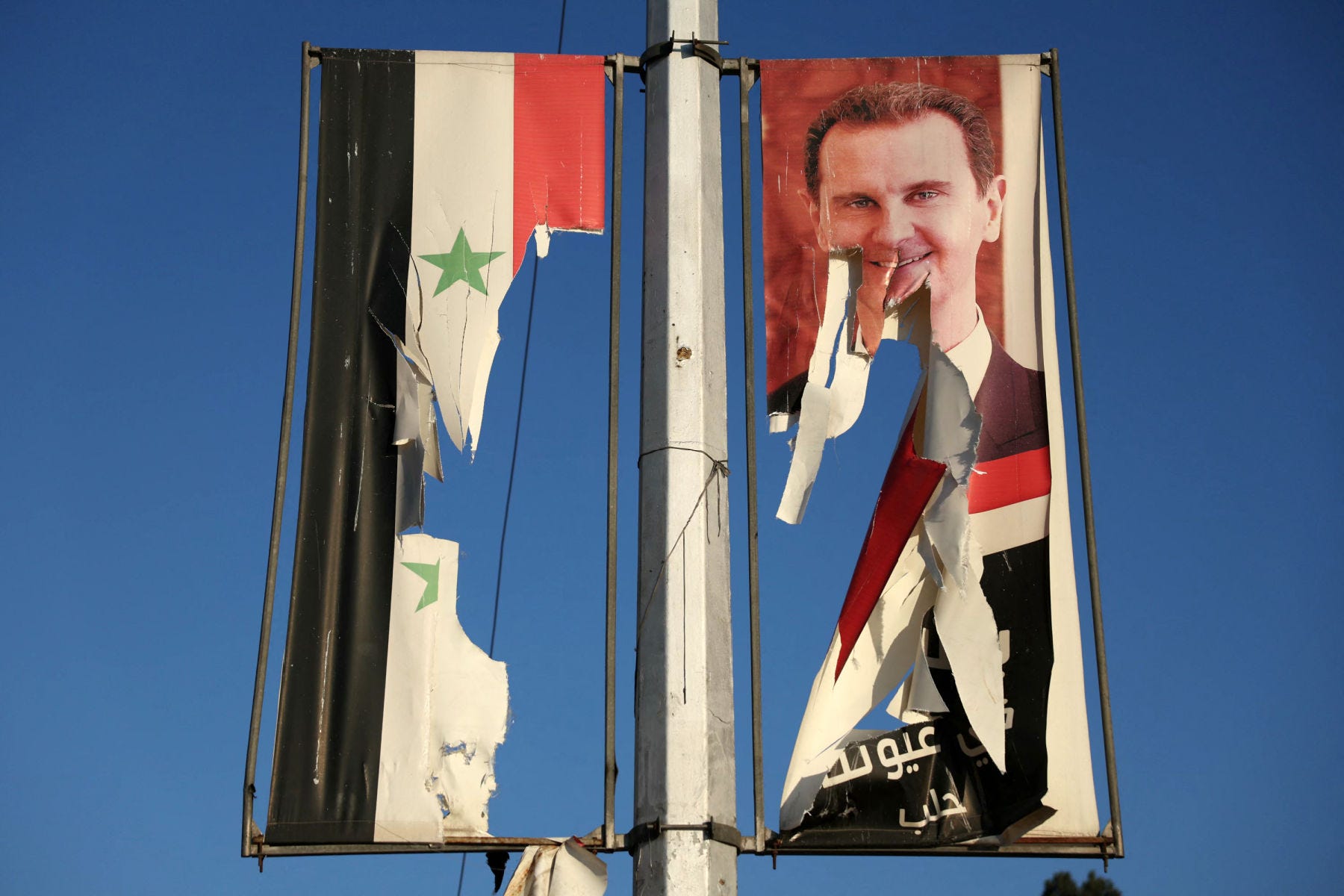
The “new normal” emerging in Syria was shattered in late 2024. In an astonishing, unexpected move, on November 27, the armed forces of HTS and its allied Islamists successfully attacked the frontline, burst out of Idlib, and headed east for Aleppo, which they conquered in just three days. They then turned south, sweeping into the central cities of Hama and Homs. At the opposite end of the country, local rebels seized control of Daraa. The Syrian armed forces mounted a half‐hearted resistance, fled, or pulled back in the face of rebel advances, effectively abandoning less strategic cities to concentrate on defending the capital. The regime’s main foreign backer, Russia, was too mired in its own conflict in Ukraine to offer any significant military or diplomatic support. Iran and Hizbullah, for their part, had recently suffered serious setbacks at the hands of Israel and were also in no position to assist. These geopolitical shifts in international relations left the Assad regime newly vulnerable. Bashar al‐Assad boarded a plane and abandoned the country to go into hiding in Russia; his brother Maher reportedly fled to Iran. On December 8, rebel forces streamed into the heart of Damascus and jubilantly declared the end of 53 years of Assad rule. A new era had begun.
The sudden overthrow of the Assad regime no doubt surprised HTS as much as it did Bashar al‐Assad. Within scarcely two weeks, a regime that had seemed solid, albeit corrupt and emaciated, had all but melted away. The leader of HTS—who now found himself effectively the new leader of Syria—marked the end of the popular revolution by abandoning his nom de guerre, Abu Muhammad al‐Jolani; henceforth he would be known by his given name, Ahmad al‐Sharaa. The family name of Sharaa immediately identified the previously mysterious figure of Jolani as originating from southwestern Syria. In fact, his family were nazihin—inhabitants of the Golan Heights forced to flee when their lands were seized by Israel in 1967.
In the immediate aftermath of regime change, HTS issued statements intended to reassure Syrians and the international community that it would respect the rights of all Syrians, including minorities, and that it would refrain from imposing measures that did not reflect the will of the people. Sharaa entertained a rapid succession of foreign dignitaries who attempted to assess the new leader and his political vision. Was Sharaa’s conciliatory tone simply a ruse to persuade Western diplomats to remove HTS from their list of prohibited terrorist organizations, lift sanctions, and open the door to reconstruction funds? Or did it express the lessons of political moderation that HTS had genuinely taken to heart over the previous seven years of governing Idlib? Sharaa’s proposal that a national dialogue be convened to draft a constitution within three years, and that national elections be held within four years, was subject to a similar interrogation. Was this timetable realistic given the chaos affecting the country, or was it a delaying tactic to allow HTS to consolidate an authoritarian regime of its own making in Syria?
Despite the historical rupture delivered by the astonishing implosion of the Assad regime, in many ways the debates in Syria of the 2020s resonated with the same set of challenges that earlier generations of Syrians had also faced.
While Syrians were rightfully concerned about the answers to such questions, whichever group came to power would have immediately faced the same set of problems. The war had destroyed a vast amount of infrastructure. There was a lack of housing, electricity shortages and insufficient jobs; tens of thousands of people were injured, traumatized or missing; millions had become refugees or been internally displaced. There was a very real possibility of revenge killings against supporters of the Assads, or those accused of supporting the regime, as well as of attacks by regime remnants who had few prospects in the new political climate and very little to lose. HTS offered a general amnesty for those who worked for the former regime: Ba’ath Party members, army officers, policemen, even Assadist militiamen and intelligence officials, flocked to have their names checked, obtain new civilian identity cards and surrender their weapons. While the rebels now controlled both Idlib and the territories of the former regime, the depth of that control remained untested. Turkish forces still occupied northern Syria, Israel still occupied the Golan, the PYD still held the northeast, and Islamic State cells were still active in the desert and the east. At the outbreak of the uprising, regime supporters had issued their ultimatum: “Assad or we burn the country.” In the wake of their departure, the Assads had left the nation in ashes.
Whatever was to follow, December 2024 ushered in one of those exceptional, critical moments in which Syria’s political future seemed genuinely undetermined. For the first time in over half a century, there was space in which political questions could at least be posed without the answers necessarily being imposed from above. Despite the historical rupture delivered by the astonishing implosion of the Assad regime, in many ways the debates in Syria of the 2020s resonated with the same set of challenges that earlier generations of Syrians had also faced.
The first was the tension between previous rulers’ desire to monopolize power, centralize authority, and impose their own vision on society, on the one hand, and the existence of powerful centrifugal forces throughout the regions of Syria agitating for their own local autonomy, on the other. The second challenge was the temptation to resolve this tension by recourse to violence. As Syria had experienced so often in its history, not only did violence beget further violence, but also created chains of complicity with violence that entangled ethnic loyalties and sectarian identities to disastrous effect.
The third challenge was that of what Syrians might call social justice. The entrenched inequalities that had characterized the country since the late Ottoman Empire were not simply the outcome of poor economic planning or suboptimal policies that could be modified by foreign direct investment, business‐friendly legislation, or the creation of free markets. More significantly, they arose from the sheer unevenness of economic development to which Syria had been exposed for nearly two centuries. Time and time again, connections between and among the cities, villages and fields of the lands of Syria were twisted, torn and transformed into new configurations by the seismic forces that shaped the global economy. Even as those who struggled for power in Syria reshaped the world around them, they did so on a terrain not of their own making but one equally shaped by international forces, transnational currents, and global crises.
While the destruction visited upon Syria was extreme, its experience of making and remaking was by no means exceptional in the modern world. In this respect—and in so many others—we have much to learn from the history of Syria, this nation that, in the words of a popular Arab nationalist slogan from the 19th century, “belongs to All.”
Excerpted from Syria: A Modern History by Daniel Neep, copyright 2026. Courtesy of Basic Books.