
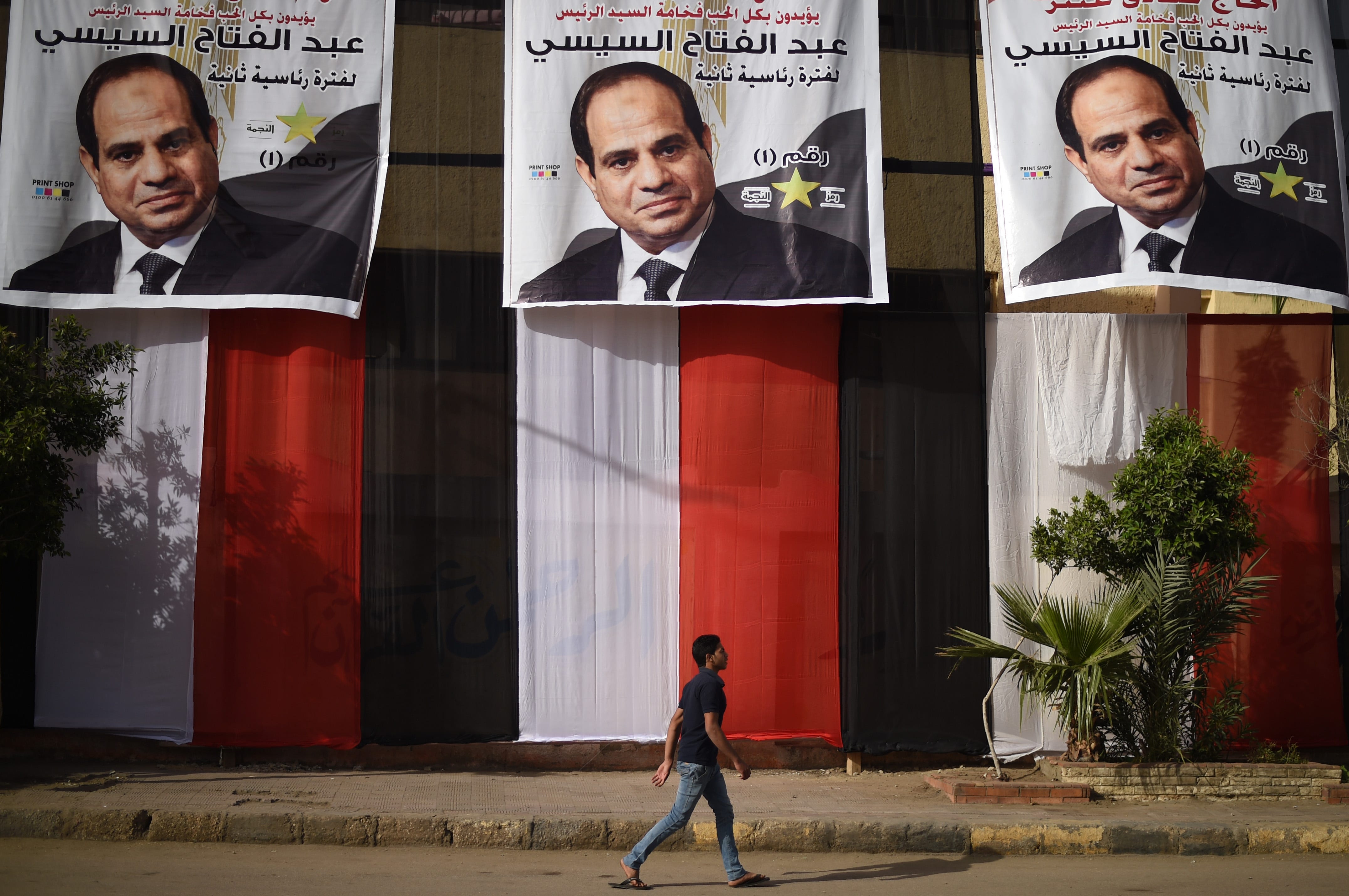
How Sisi's Militarized Urbanism Is Remaking Egypt
Sisi's regime has securitized public spaces and built mass surveillance into urban planning in a quest to turn Egypt into the “perfect military camp.”

Counterrevolutions are often assumed to restore the ancien régime, but Egypt’s trajectory under President Abdel Fattah al-Sisi, who seized power in a coup in 2013, challenges this notion. While the counterrevolution triumphed, its leader set out to construct an entirely new order—what he called a “New Republic” or “Second Republic.” Figures from the era of Hosni Mubarak may still linger, but their influence has steadily waned as they adapt to new rules in an unfamiliar political landscape. Sisi—for the first time since 1952, when the Free Officers movement toppled King Farouk and ended Egypt’s monarchy—succeeded in unifying Egypt’s coercive apparatus and empowering it to dominate the state. The result is a republic without a social contract, devoid of hegemony, locked in an existential war against its own people, and operating more like a colonial occupier than a national government.
During Sisi’s first presidential term, debate persisted over the nature of the post-coup order, with many viewing it as a mere restoration of Mubarak’s regime. Today, few observers or ordinary Egyptians doubt that Sisi’s rule is fundamentally different. While the unprecedented scale of repression is often noted, little scholarship has examined why it has reached such extremes or what dynamics drive it.
The unification of Egypt’s repressive apparatus under Sisi has meant drastic implications for the rest of the state institutions. The Second Republic was founded on contempt for civilians, civilian institutions, let alone civilian rule. Sisi embarked, with the full support of the senior brass, to militarize state organs and securitize public spaces in a quest to turn Egypt into what Michel Foucault envisioned as the “perfect military camp.”
The urban landscape has undergone radical change since 2013, especially in Cairo, Giza, Alexandria, and other large cities. The state has become bolder in demolishing entire poor neighborhoods—something Mubarak long attempted but failed due to residents’ resistance. By brute force, the Second Republic surpassed even Mubarak’s ambitions. From 2018 to 2022, over 2 million residents in Cairo and Giza—about 10 percent of their population—were displaced, according to anthropologist Omnia Khalil. The aim of these non-stop demolitions is not just to clear out the poor; the drive echoes post-1848 Paris, rebuilt after the uprising against King Louis Philippe I was crushed to enable swift troop deployment and control of public space. Sisi’s urban planners cite “security access” as a key element behind the drive for widescale home demolitions and for building bridges, especially in Greater Cairo and Alexandria.
Also, in the grand scheme of military domination, “Bridges fragment communities,” says historian Khaled Fahmy. “The bridges and highroads that they are building atomize society, which is us, the enemy and source of worry. They also serve to eliminate public space. Where do Egyptians gather and meet? The squares and streets. These are being taken away to deprive us of social unity.”

The man behind Cairo’s disfigurement has been Mustafa Madbouly, appointed by Sisi first as housing minister in 2014 and later as prime minister. Madbouly comes from a powerful family with military ties. His father, Kamal Madbouly Nassar, was an artillery major general and a close associate of Field Marshal Mohammed Hussein Tantawi. He is also related to Major General Ibrahim Fouad Nassar, who headed the Military Intelligence (1972-75) and later the General Intelligence Service, or Mukharabat (1981-83). The enforcement of these urban changes and community uprootings occasionally triggered rare protests, mostly against the police. Units of the Central Security Forces, the Ministry of Interior’s paramilitary, are usually deployed during evictions. In September 2021, Sisi threatened to send in the army, though its role remains largely confined to Sinai and the northwestern coast. Recent urban changes have also included a state-led tree-culling campaign, carried out by municipal authorities under the Ministry of Local Development, not only during road expansion. From 2017 to 2020, Cairo lost about 910,894 square meters of green space, a figure that is likely higher today. Officials gave no clear justification, but urban planners suggest the culling is part of securitizing the landscape.
During the revolution, millions prophetically chanted: Yasquṭ yasquṭ ḥukm al-ʿaskar! Maṣr dawla miš muʿaskar! (Down with military rule! Egypt is a state, not a [military] camp!) Today, the Second Republic is turning the country literally into one large military camp.
Sisi embarked, with the full support of the senior brass, to militarize state organs and securitize public spaces in a quest to turn Egypt into what Michel Foucault envisioned as the “perfect military camp.”
The Second Republic is not content with merely transforming historic urban centers—where most of the population has lived for centuries—into a “perfect military camp” under the permanent gaze of the repressive apparatus. It has also sought to construct new “camps,” where surveillance is built into urban planning. Sisi announced a plan to build fourteen “smart cities” nationwide, including the New Administrative Capital, in a vast stretch of desert some 40 miles east of Cairo, and New Alamein, a summer capital on the northern Mediterranean coast. By 2030, these cities are projected to expand the urbanized landscape of Egypt from 6 percent to 12 percent. Digitalization of services, sustainable development, and green energy are the stated goals. While this vision suggests a potential improvement in quality of life, in practice “smart” has become a euphemism for surveillance, part of broader post-2013 trends in architecture and planning. Some of these trends predated the coup but gained momentum after it, while others represent a clear departure from earlier First Republic traditions.
Since the rule of Khedive Ismail (1863-79), the government left the citadel on Cairo’s Moqattam Hill and moved into the expanding city, then undergoing major replanning and construction to house the government, manage pandemics, and improve sanitation. This reflected a vision in which the elite felt safe in a city with functioning services and a police force professional enough to guarantee security. Under the First Republic, few attempts were made to relocate government institutions, though President Gamal Abdel Nasser moved some to Nasr City in eastern Cairo. Later, President Anwar Sadat proposed relocating ministries to Sadat City, a new satellite city 60 miles north of Cairo, but the project ended with his death. The drive to build “new cities” until the mid-1990s was not to serve the elite but to displace the urban poor, workers, and lower middle classes, freeing central Cairo for elite enjoyment. By the late 1990s, however, Egypt witnessed the spread of gated compounds for the wealthy outside the capital. The more recent relocation of government to a desert city represents a sharp break from this two-century trajectory, signaling a return to the citadel model of governance.

The motives behind Sisi’s New Administrative Capital are many. He is driven by megalomania and the desire to expand military business, but the move also reflects an ideological goal: preventing another revolution. Strikes, roadblocks, or riots should never again paralyze the state as in 2011, according to this vision. The ruler of the Second Republic has abandoned the old city and even the entire valley. For him, “Egypt” is the New Administrative Capital and New Alamein—two citadels linked by a fast train. The military even proposed that civil servants in the new capital wear a unified uniform, adding an Orwellian layer of visual conformity to a city already designed as a monument to centralized control.
The government insists the new capital is not “fortified,” yet its designs reveal a gated city with round-the-clock surveillance. Major General Ahmad Zaki Abdin, who Sisi appointed to oversee the New Administrative Capital project, confirmed streets will be monitored by over 28,000 CCTV cameras linked to an Ministry of Interior “security control center.” Inside, quarters such as the residential areas, the Presidential Palace, and the Embassies district will be walled off or gated. “This means once you enter the city, you are monitored and effectively have nowhere to go,” says one urban planner. While such plans may evoke Sci-Fi cyberpunk images, the planner adds, “It is not exactly post-apocalyptic. The apocalypse is still happening now in front of our eyes. The old cities are melting down and degenerating, while Sisi offers a certain class in society a chance to live elsewhere in a place where services will be provided and institutions will be functioning, unlike the rest of the country.”
Editor’s note: This essay is adapted from Counterrevolution in Egypt: Sisi’s New Republic by Hossam el-Hamalawy, published this month by Verso.


