


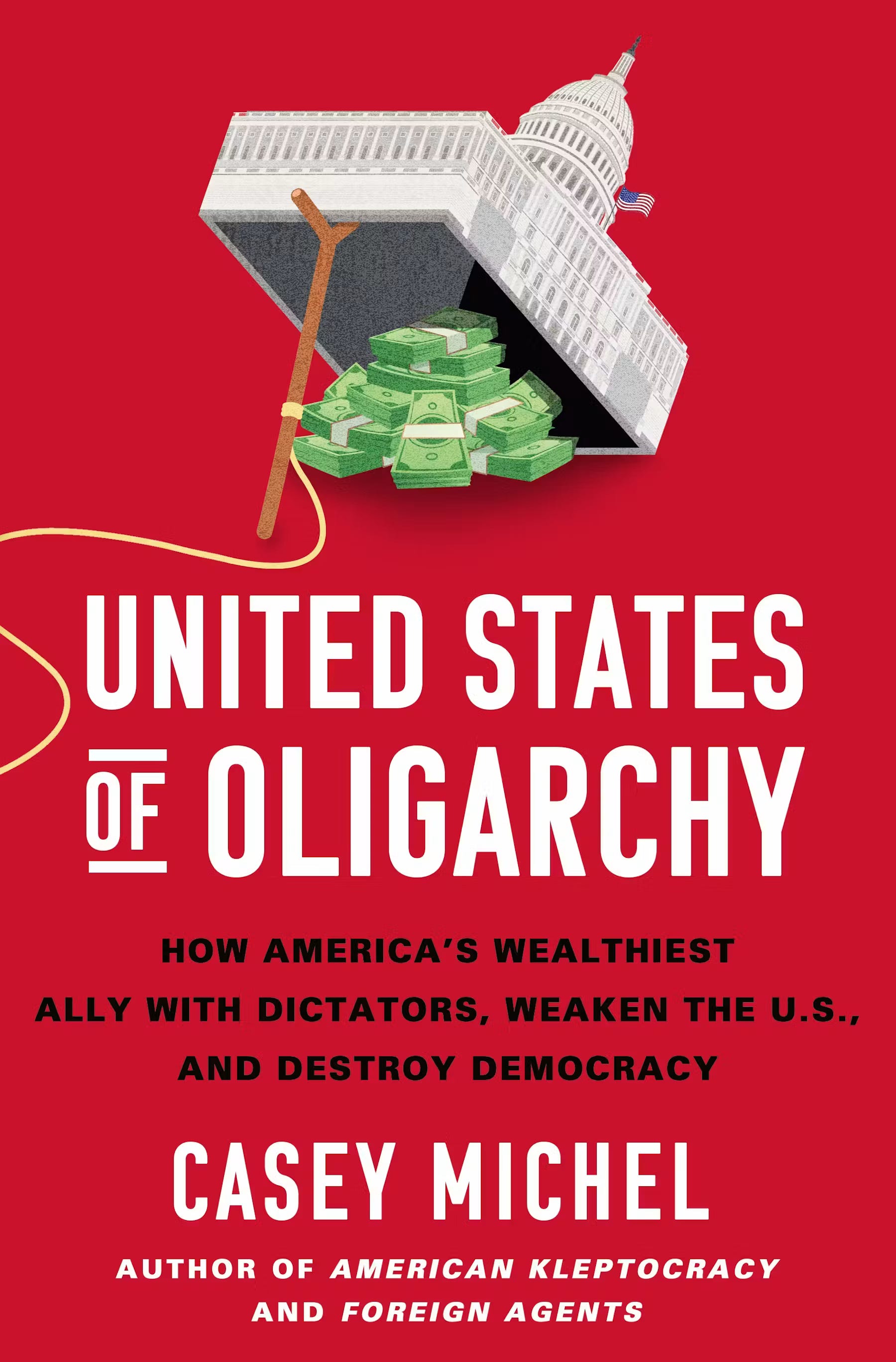
Casey Michel is an author, journalist, and non-resident senior fellow on corruption at the Center for International Policy. He is the author of American Kleptocracy, Foreign Agents, and United States of Oligarchy, out now from St. Martin’s Press and from which this essay is adapted. He writes regularly for The New York Times, The Wall Street Journal, Financial Times, The Atlantic, Foreign Policy, and other outlets on the intersection of corruption and democracy.
Help sustain Hidden Cities and independent journalism illuminating the world with this special subscription offer.
By the early 2020s, the idea of foreign despots throwing billions of dollars at American investment firms had become normalized to the point of being blasé. Little matter that these regimes built their wealth on the backs of broken bodies and bombed-out neighbors, on concentration camps and assassinated journalists, on inflaming or authoring genocides both at home and abroad. Two decades into the 21st century, it seemed like every major investment firm in America—run by a president’s son-in-law or otherwise—had opened its doors to foreign regimes or their oligarchic foot soldiers, cracking open the American economy for as many vampiric, kleptocratic regimes as they could. Investment funds had, by the 2020s, become the perfect pass-through vehicle for foreign regimes looking to influence American policy—especially those funds run by American oligarchs themselves.
In many ways, it was an unsurprising development. In the United States, a decades-long loophole had exempted American investment firms—private equity, hedge funds, venture capital, and others—from basic anti-money laundering requirements. Similar to a decades-long loophole that allowed illicit wealth to flood America’s real estate market, the lack of money-laundering checks for U.S. investment firms acted as a major magnet for dirty money around the world. As the 21st century trundled on, American private investment funds became a perfect tool for transnational money laundering, mixing kleptocratic wealth with other investors and scattering that money across the American economy. Small wonder that American capital markets have exploded over the past few decades, climbing into the trillions of dollars by the early 2020s, with no reason for slowdown in sight.
“For years, gaps in rules for the private investment industry have led to countless cases of the corrupt stashing their illicit gains in U.S. hedge funds, private equity and venture capital,” Gary Kalman, the head of Transparency International’s U.S. chapter, said. As a leaked FBI memo in 2020 revealed, Russian oligarchs had already laundered their cash via American investment funds. So, too, had Mexican cartel operatives, opening hedge fund accounts to cycle their drug money into the U.S. Other hedge fund representatives had specifically proposed their funds as a means of moving “prohibited items from sanctioned countries to the United States”—using American loopholes to gut American sanctions.
Investment funds had, by the 2020s, become the perfect pass-through vehicle for foreign regimes looking to influence American policy—especially those funds run by American oligarchs themselves.
Because of the lack of transparency requirements—because these firms could mask their investors, even when the chairman of the Senate Finance Committee came calling—we have incredibly little insight into which regimes have bankrolled specific American firms. We have little idea how much of the multi-trillion-dollar holdings now in American capital markets originated in places like China, Russia, Iran, Venezuela, or elsewhere. And we have almost no data on just where that money ended up—let alone how much return on investment, either financial or political, those regimes received in turn.
But by the mid-2020s, we started to get at least some idea on what regimes were expecting from all this investment. After Donald Trump lost his reelection bid to Joe Biden in 2020, his son-in-law Jared Kushner, a failed real estate investor who Trump had made a top foreign policy adviser, quickly transformed into a billion-dollar dartboard for Gulf autocrats, cashing in on ties he had cultivated in the White House. Saudi Arabia, the United Arab Emirates and Qatar all funneled vast sums of money into his new private equity firm, Affinity Partners, which had no investment track record to speak of. To call the firm unproven or fledgling would be a compliment, as Kushner had never managed an investment fund before. Affinity was amateurish and looked like nothing more than a vehicle for foreign governments to “invest” in Kushner—and perhaps, by extension, Trump—with generous management fees to boot.
Kushner’s move, just out of the White House, was unprecedented in American politics. It was arguably one of the most breathtaking pay-to-play schemes America had ever seen. Never before had a former administration official hopped out of office, launched their own fund, and immediately watched billions stampede in. Perhaps the only thing more shocking was that Affinity’s rise barely caused a scandal in the U.S.
But if anything, Kushner was just a microcosm, a synecdoche—a sign of just how far the entire world of American private equity, hedge fund, and venture capital market funds had drifted in a pro-dictatorial direction. How oligarchic forces around the world had swamped American private investment funds, and how they wrapped themselves around American oligarchs in the process, piling their wealth on top of one another. It was almost breathtaking to behold—all the more so given how little insight we actually had into any of it.
Still, every once in a while, something acted like a torchlight on the topic, highlighting just who was taking advantage and what it might mean for American politics, even beyond Kushner. Because in 2023, something slipped through all that anonymity. It wasn’t a leak, and it wasn’t a breach. It was, instead, a voluntary disclosure of just who one particular regime had been backing—and all the American firms, and all the American oligarchs, who’d been profiting along the way.
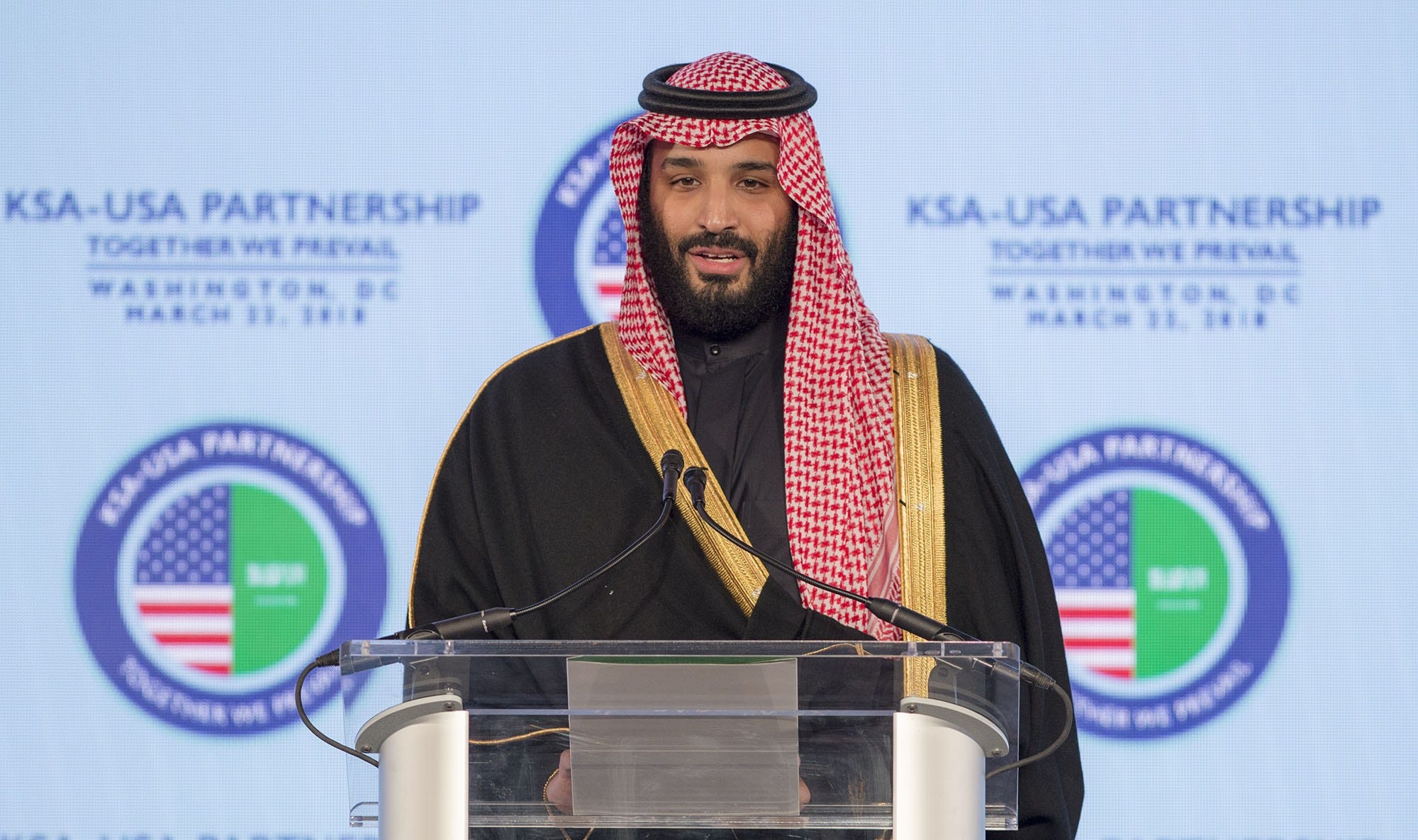
In 2008, at the height of the global financial crash, the Saudi regime wanted to form its own investment arm—something that could target and identify potential assets and potential partners around the world, all scouring around for much-needed capital. With an early injection of $8 billion, the new regime-controlled entity, dubbed Sanabil, claimed it wanted to “transform groundbreaking ideas into tangible realities”—and, it went without saying, create bridgeheads for the Saudi regime to further extend its interest and influence wherever it could.
For years, the targets of Sanabil’s investments were largely unknown. Given the dearth of transparency requirements—to say nothing of the public relations risk of taking funds from a regime as monstrous as the Saudis—that shroud of secrecy shouldn’t be surprising. In the U.S. in particular, firm after firm the Saudis could theoretically target were “cagey about whether they have raised money from Saudi Arabia,” unwilling to reveal whether or not they were in bed with the regime.
There were rumors, of course, and enough breadcrumbs to follow Saudi money into American investments. Silicon Valley had long had “deep connections” with Saudi Arabia, with Crown Prince Mohammed bin Salman himself even visiting California in 2018 to meet directly with Apple’s Tim Cook, Google’s Sundar Pichai, and others. OpenAI’s boyish head, Sam Altman, even spent time serving on the advisory board of Saudi Arabia’s plans for the new, surreal city of Neom, set to include multiple skyscrapers and planned to run one hundred miles long. But the ultimate recipients of all that Saudi money remained a mystery.
In March 2023, however, Sanabil decided to drop the veil. On its website, the Saudi investment arm publicly listed all the private investment partners it had piled into its own portfolio—all the private equity, hedge fund, and venture capital funds it had decided to pump up, transforming into fronts for Saudi money to be fire-hosed around the world, and in particular the U.S. The reasons for Sanabil’s disclosure remain unclear; the Saudis themselves never bothered to reveal why they had posted all the identifying information of their investment partners. Perhaps it was arrogance. Perhaps it was oversight. Perhaps it was leverage over their partners, ending their plausible deniability and reminding them who their ultimate paymasters were—and what those paymasters were capable of.
The reasons ultimately didn’t matter. For the first time, we got insight into just which private equity heads, hedge fund managers, and venture capitalists the Saudis had been backing—and those Americans who’d bundled Saudi financing into new projects in industry after industry, plumping up not only other companies themselves but also some of the wealthiest, and increasingly antidemocratic, voices around the nation.
The total list runs to some 50 firms, listed alphabetically on Sanabil’s website. There were, as The Information wrote, “marquee investment firms” like Craft Ventures and Insight Partners, with Forbes also flagging some of the “biggest names in Silicon Valley,” like Iconiq Capital and Tiger Global. All told, there were dozens of firms who had taken billions of dollars from the Saudis, swelling their coffers even as the Saudi regime sank further and further into a totalitarian theocracy.
Ride-share companies like Uber, meal delivery companies like DoorDash, even messaging platforms like Slack—all of them ended up funded by private equity or venture capital funds buoyed by Saudi riches. These private equity firms had effectively become pass-through vehicles for all the dirty money spewing out of Saudi Arabia—cutouts to help the Saudis back start-ups, established companies, and everything in between. The Saudi financing flowing throughout Silicon Valley was, as The Wall Street Journal wrote, “unprecedented.”
The American funds themselves have all, as of this writing, refused to comment on the Saudi connections, or on the Saudi decision to disclose their partnerships. But as one tech CEO speculated, “There’s no way you could found a start-up in this [venture capital] community and not be beholden to MBS or someone one step away from him.” Whatever qualms Silicon Valley may once have had about doing business with Saudi had clearly crumbled. If there was ever any handwringing or moral concern, Vox wrote, “tech investors have clearly moved on.”
It was hard to disagree. There was, it appeared, no bottom—no line the Saudis could cross that would close the doors to business partners in the U.S. Murder and shred the limbs of a journalist who worked at your newspaper? No matter, at least for Jeff Bezos, with Amazon agreeing to help Saudi Arabia construct an “AI Zone” in the country. Claims that you’re concerned about governmental censorship, governmental overreach, and governmental tyranny? Not a problem, at least for Peter Thiel, whose Founders Fund was revealed as one of Sanabil’s partners. Everyone, as the Saudis figured, could be bought. Were they wrong?
But it wasn’t only that these firms were taking Saudi money. To hear these tech oligarchs tell it, the Saudi regime was hardly one of the most repressive governments on the planet. It was, instead, a potential model of the future—a model of what could be achieved if a government had the right people atop it. Indeed, this infatuation with Saudi tyranny revealed perhaps more than anything else the ultimate goal of what many American oligarchs envisioned for a future in the U.S. Not the theocratic elements, necessarily. But the pairing of wealth and power—a regime that sloshes hundreds of billions of dollars at the supposed visionaries peopling Silicon Valley, without any concerns for silly things like democracy—was the ultimate end goal for these tech oligarchs.
It wasn’t only that these firms were taking Saudi money. To hear these tech oligarchs tell it, the Saudi regime was a potential model of the future.
In 2023, a Saudi think tank hosted its own conference in Miami. Some of the names in attendance were expected, such as Kushner, while others were a bit more off-the-wall, such as DJ Khaled and disgraced baseball player Alex Rodriguez. Much of the conference, however, appeared dedicated to little more than lavishing the Saudi regime with praise—to confirming, as one journalist wrote, that it was “no longer shameful to accept massive investment dollars from Saudi Arabia.”
It wasn’t simply that it was no longer shameful; it was now, for many in Silicon Valley, a point of pride to be seen doing business with a totalitarian regime like Saudi Arabia. “The more I think about it, the more Saudi almost feels like a startup,” hummed WeWork founder Adam Neumann, summing up the conference’s theme. Added another venture capitalist named Ben Horowitz, “Saudi has a founder. You don’t call him a founder, you call him ‘His Royal Highness,’ but he’s creating a new culture, he’s creating a new vision for the country, he’s got a very exciting plan to execute, and the people in the country are fired up to do it.” No foreign lobbyists, paid-off PR specialists, or propaganda hacks could have said it better.
Nor did it end with those initial investments or public pleasantries. In 2024, The New York Times reported that Andreessen Horowitz—a venture capital firm overseen by the aforementioned Horowitz and his partner, Marc Andreessen, which itself backed everything from Airbnb to Facebook—had entered talks with Saudi Arabia to “create a $40 billion fund to invest in artificial intelligence,” which “would dwarf the typical amounts raised by U.S. venture capital firms.” The move would directly partner Andreessen Horowitz with the Saudi sovereign wealth fund, allowing the Americans to tap into billions more out of Riyadh—and allow the Saudi dictatorship to sink its teeth that much further into emerging AI technology in the U.S. and elsewhere.
The investment could, of course, be anodyne. Maybe MBS wants to harness new AI technology to, say, help ChatGPT and its competitors provide more coherent responses to students’ questions, or to create more impressive, more immersive AI-generated artwork. Or maybe, just maybe, it’s for something else—for the same thing that despots since time immemorial have sought out new technology: to remain in power, in perpetuity. And to beat back any threats to their rule, wherever they may be found, using whatever tools—and whichever oligarchs—they could.
On its own, the prospect of a regime like Saudi Arabia gaining access to proprietary AI technology is harrowing—and that’s even before considering the leverage the regime has over someone like a sitting president’s son-in-law. Yet by the time the Saudi regime began partnering with Andreessen Horowitz, that was nowhere near the most pressing concern. Saudi Arabia, after all, was only one regime. And MBS was only one tyrant. But by the mid-2020s, American politics had burst open for all comers—for anyone who wanted to hide money behind American corporations, and make all those concerns following Citizens United about the safety of American elections become a crashing, catastrophic reality.
From UNITED STATES OF OLIGARCHY: How America’s Wealthiest Ally with Dictators, Weaken the U.S., and Destroy Democracy by Casey Michel. Copyright © 2026 by the author and reprinted by permission of St. Martin’s Publishing Group.
